
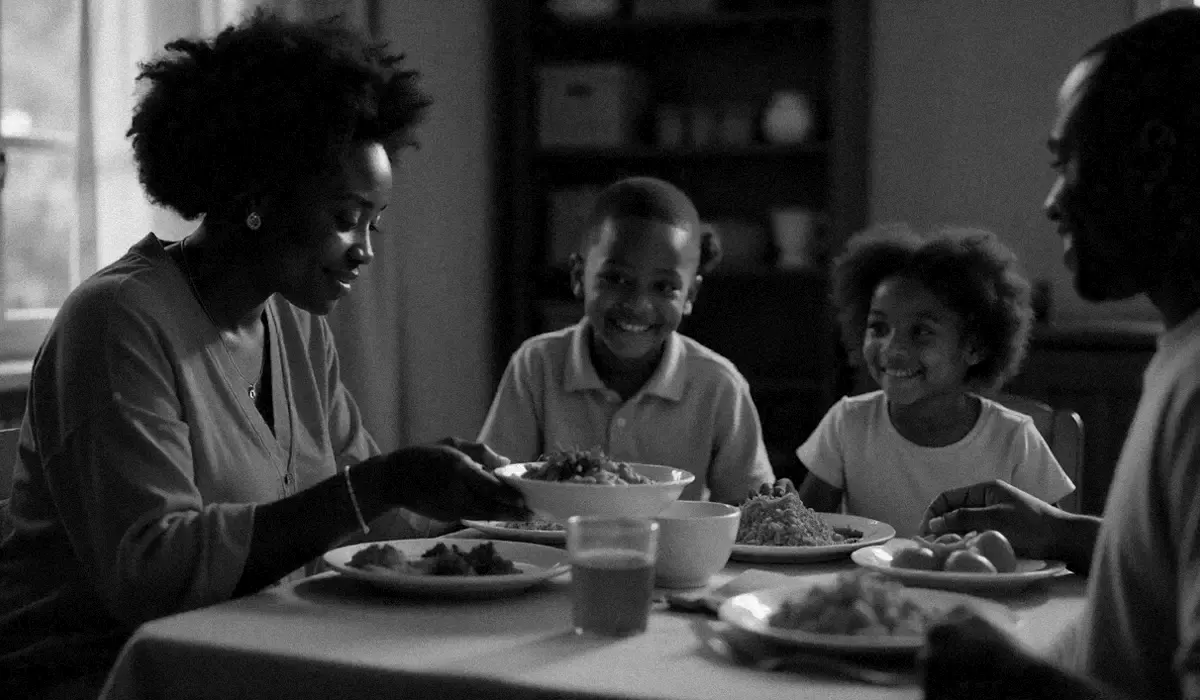
I visited home today and realised how long it had been since I last sat down for a proper family dinner. And not for having moved out, even before deciding to hustle out life on my own, I had slowly drifted into this habit of eating alone, either long after everyone was done, or at my study table with my laptop open and a half-finished article staring back at me. No one complained. In fact, mum would politely say, “Just eat from there if you’re busy.” And at the time, it felt normal. Practical, even. I was working, after all.
But today it hit different. It made me stop and wonder how we got here. For all my earlier years of life, family dinner was non-negotiable. And not just in my home, across Uganda, dinner time was family time. You dropped whatever you were doing, washed your hands, and showed up. Whether you wanted to or not. You didn’t debate it, you didn’t negotiate, and you certainly didn’t hide in your room pretending to be asleep so you could skip the session. In fact, the Mwalimu of the house could even be waited for; no eating with someone missing.
And while it was annoying at times, especially when you’d rather be outside playing, it was also warm, chaotic, and fun. It was where jokes were cracked, where siblings teamed up to tease that one last born refusing to eat nakati, and where we learned to say our food prayers. Come to think of it, family dinner was where part of our identity was quietly formed…don’t sit like that, ‘tosimba kakono’ and other small life lessons.
It was boring too at times, sitting through grown-up programmes like having to watch the news because Mum insisted “you need to know what is happening in your country,” lol. But it was family.
Today, things feel different. Many of us youth see family dinner as optional, and most would rather eat on their own. Parents are neck-deep in hustle culture and evening side gigs. Kids returning from school find the food already dished up in the fridge. Even when everyone is home, phones, screens, and remote work quietly pull people away from the table.
So, what changed?
Honestly, if you are wondering too, I blame it largely on modern life. We’ve entered an era where hustle culture has swallowed our evenings whole. Longer commutes, evening classes, side gigs, late clients, tight deadlines, and remote work that somehow stretches deep into the night. Many parents today return home tired, mentally drained, and with barely enough energy to even sit at a table to talk. Eating, for many of us, is a quick, individual task, a survival activity, no longer a shared moment.
Even those working from home often don’t “switch off;” laptops stay open; tasks spill into the evening, and dinner becomes something grabbed quickly between tasks.
This change in routine is one of the biggest contributors to why structured family routines have collapsed.
And for many young people, the bedroom has quietly become the new dining room. A plate of food in one hand, a phone in the other, Netflix open, YouTube running, chats buzzing, everything happening in that one private corner. Even when everyone is home, people are scattered across rooms like small islands drifting in different directions.
Screens don’t help either. First, it was the TV; suddenly, we were all facing a screen instead of facing each other. Then smartphones entered the picture, and the dining table lost the battle completely. A family could physically sit together, but mentally everyone is somewhere else… scrolling, replying, updating, watching, consuming. Presence without presence. Walk into any establishment, restaurant, bank, or hospital, and you will find someone on their phone, even when they are with someone. Our screens are never far away from us.
And then there’s school. Many Ugandan children spend most of the year in boarding schools. Their eating routine is dictated by bells and dining halls. When they return home for the holidays, there’s no strong dinner rhythm to return to–they simply serve themselves whenever they want. The culture that once held family dinner together becomes weaker with each generation.
Even the way we live has changed. Urban housing has shrunk, especially in Kampala. Some apartments don’t even have dining spaces. The “dining table” is now the couch, the bed, or the kitchen counter. When the space disappears, the habit disappears with it.
But the thing is… family dinner was never really about the food, well, not entirely. It was more about family and having time together. To wind up the day. Stories came out, and parents observed their children and caught up on their moods without asking directly. Siblings learned each other’s mannerisms while advice slipped naturally into conversation. Remembering it now, it’s when the home felt like a home.
Losing it comes with subtle consequences. For example, there have been reports that modern children are losing communication skills, an outcome of the distance growing slowly between people. Conversations thin out. Everyone becomes busy independently. Children develop their own worlds inside their rooms. Parents miss the opportunity to notice subtle emotional shifts. Homes remain full, but the sense of togetherness becomes hollow.
Sometimes, we don’t even notice it happening. We just wake up one day and realise it has been years since the last real family meal. The feeling around it. The laughter. The unwinding. The shared humanity. The sense of belonging.
And if we’re being honest, it’s something worth bringing back, even with how busy modern life gets.