
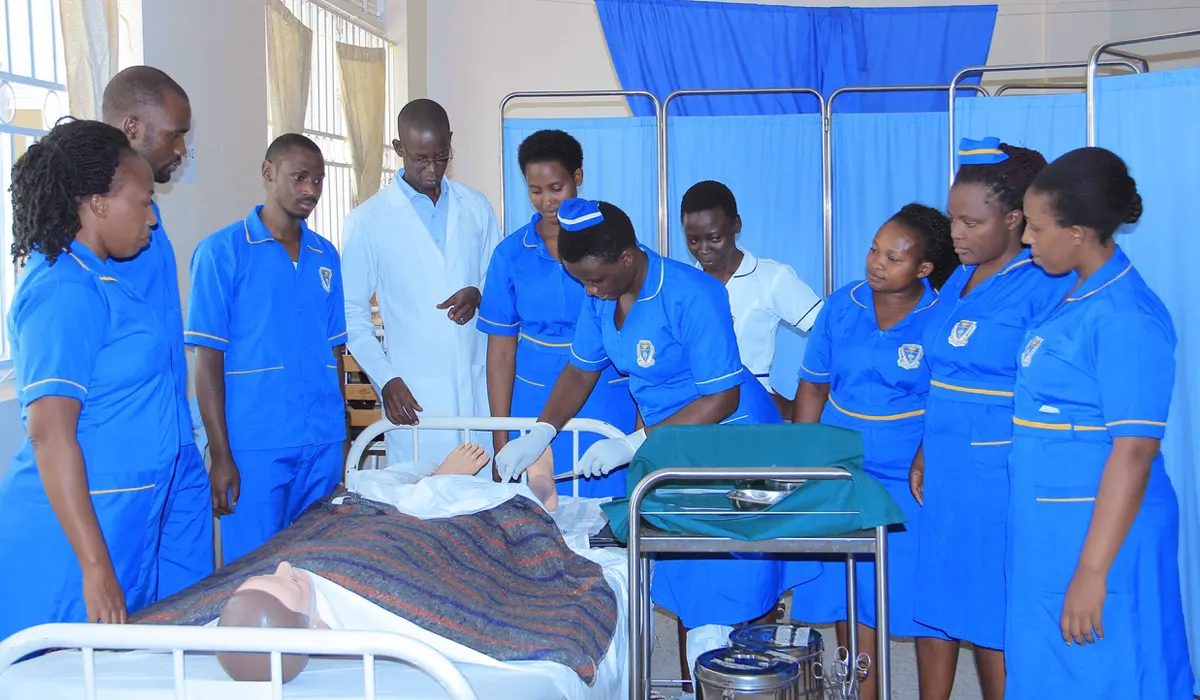
For many youths, especially girls branching off at the Senior Four level, nursing has long been one of the most popular courses to take. Many choose it for a variety of reasons, but mostly because it is seen as a safe bet: a career where there is always work. And yet, despite this perceived security, not many actually reap the benefits.
Marium, a close friend of this author, recently graduated from nursing school, shared her experience and that of many of her peers, which became the biggest inspiration for today’s article.
When you talk to Marium about her chosen trade, the first thing she will tell you is how much it costs to do nursing. About UGX 3 million per semester in tuition alone, not counting the specialised tools she had to buy for herself. And when we talk about tools, pens and pencils are the least of her worries. We’re talking blood pressure machines, stethoscopes, her own supply of masks, gloves, and other clinical tools.
She’ll also tell you about the long study hours, the long-standing hours during practical lessons, the unpaid placements while still a student, and the constant innuendo, not only from patients, but sometimes from lecturers as well. Add to that the usual lifestyle and well-being struggles of campus life, and it quickly becomes clear that nursing school is no walk in the park.
Looking back at this investment of time, money, and effort, Marium admits she expected life after graduation to feel more secure. After all, nurses are said to be in demand, and government messaging constantly highlights health workers as essential professionals. However, her wake-up call came with the mandatory one-year internship, a period that, for many young nurses, is either unpaid or very poorly facilitated, despite requiring full-time work.
It is usually at this point that many begin to ask the difficult but necessary question: Is studying nursing in Uganda still worthwhile?
For the faint of heart, this is often where nursing graduates begin to resemble other university graduates, struggling to secure satisfying jobs and slowly joining the wider hustle culture.
Why Nursing Remains a Popular Choice in Uganda
Despite these realities, nursing continues to attract thousands of students every year, and for understandable reasons. It is widely viewed as a “safe” course, one with clear pathways, recognised qualifications, and the promise of employment both locally and abroad.
Compared to other science courses, nursing is often seen as more accessible, especially for students who may not have strong grades in advanced sciences. Many view it as a second chance, beginning with the basics of medicine and then upgrading through certificates, diplomas, and degrees.
There is also a strong social element at play. Nursing carries a certain prestige, regarded as respectable, stable, and service-oriented. For many families, it is a reliable investment in a child’s future, inspiring the classic “we have a doctor in the family” boast. In a country with high graduate unemployment, the logic appears simple from the outside: aren’t more nurses a good thing?
However, popularity alone does not guarantee sustainability, especially when the financial and emotional costs of training are factored in.
The True Cost of Becoming a Nurse in Uganda
On paper, nursing may appear cheaper than courses like medicine. In reality, the total cost adds up fast. Tuition at many private institutions runs into millions of Ugandan shillings per semester, and even government-sponsored students face numerous hidden expenses rarely disclosed upfront.
Clinical tools, uniforms, examination fees, placement facilitation, transport to hospitals, and sometimes accommodation all come from the student’s pocket. Over several years, families often spend amounts comparable to those for traditionally “high-paying” professions.
Beyond the money, nursing is highly practical. Students don’t just sit in lectures; they work. Marium described her training as actual shift work, since her nursing school was attached to a hospital. Long hours of service before graduation exposed her early to the profession’s hazards: night shifts, sexual innuendos, heavy responsibility, and, of course, no pay. External public placements in other hospitals followed, bringing their own challenges.
Most students make these sacrifices believing the struggle will eventually pay off–that suffering now will lead to stability later. For many, this is where reality starts to diverge from expectation.
The Internship Year: Training or Exploitation?
After graduation comes the mandatory one-year internship required for registration. In theory, it helps newly trained nurses consolidate their skills under supervision. In practice, many interns describe it as one of the toughest phases of their careers.
Intern nurses often cover understaffed wards on full shifts without official employee status or bargaining power, leaving them vulnerable to delayed, inconsistent, or even unpaid allowances.
For graduates who have already exhausted their financial sources during school, this year can be brutal. Rent, transport, food, and basic living costs keep coming, even while you’re an intern. For some, this is when passion for the profession starts to fade, and many quietly turn to side hustles to survive.
Pay Versus Reality: Where The Numbers Fail
Once registered, the financial situation does not improve as much as many expect. In private health facilities, fresh nurses earn around UGX 300,000 per month. Intermediate nurses average about UGX 500,000, while senior nurses or department heads may earn over UGX 700,000.
Of course, these figures depend on location, qualifications, and bargaining power; factors many fresh graduates lack unless they can leverage strong social connections.
In public service, pay is generally better on paper due to government recognition of science-related professions. However, competition for these positions is stiff, deployment can take time, and available vacancies rarely match the number of graduates being trained each year.
When these salaries are weighed against the training costs, years of study, and job demands, the return on investment appears weak. For many nurses, earnings barely cover basic living expenses, let alone savings, family support, or long-term planning.
This gap between effort and reward explains why many nurses look abroad, leave the profession, or rely heavily on side hustles to make ends meet.
Beyond Money: Burnout and Working Conditions
The challenges of nursing in Uganda go beyond finances. Many nurses work in understaffed facilities with limited equipment and overwhelming patient loads. Long hours, emotional exhaustion, and constant exposure to illness and trauma take a heavy toll.
For young nurses just entering the workforce, the combination of low pay, heavy responsibility, and little recognition can be deeply discouraging. Burnout sets in early, and the passion that once drew them to the profession gradually fades under daily realities, realities the profession itself struggles to sustain.
So, Is Nursing Still Worth It?
Like many career and life questions, the answer depends on who is asking and why.
For those driven by passion and service, nursing can still feel fulfilling, especially for those who endure the difficult early years and gain enough experience to negotiate better conditions. The profession offers purpose, human connection, and the chance to make a real difference in people’s lives.
For those with access to opportunities abroad, further specialisation, or strong financial and family support, the long-term outlook can remain positive. Marium believes that with the right resources, changing her work location after registration would be worthwhile. She points to countries such as Germany and the USA, where pathways are clearer, and the profession receives stronger support.
For students entering nursing expecting quick financial stability and without a realistic plan to expand their skills, the reality can be harsh. High training costs, unpaid or poorly paid internships, low starting salaries, and difficult working conditions make nursing a tough investment in Uganda.
Because advancement often demands more money and time, many remain stuck at the certificate level, unable to upgrade. From that point, nursing can start to feel like a dead end rather than a ladder.
What Prospective Students Should Know
Before choosing nursing, students and parents need honest information. Nursing is not a shortcut to employment or wealth. It demands resilience, patience, and a clear-eyed understanding of the sacrifices involved.
For some, it will still be worth it. For others, it may not be. What matters most is going in with open eyes, not just the popular narrative, but the full picture.