
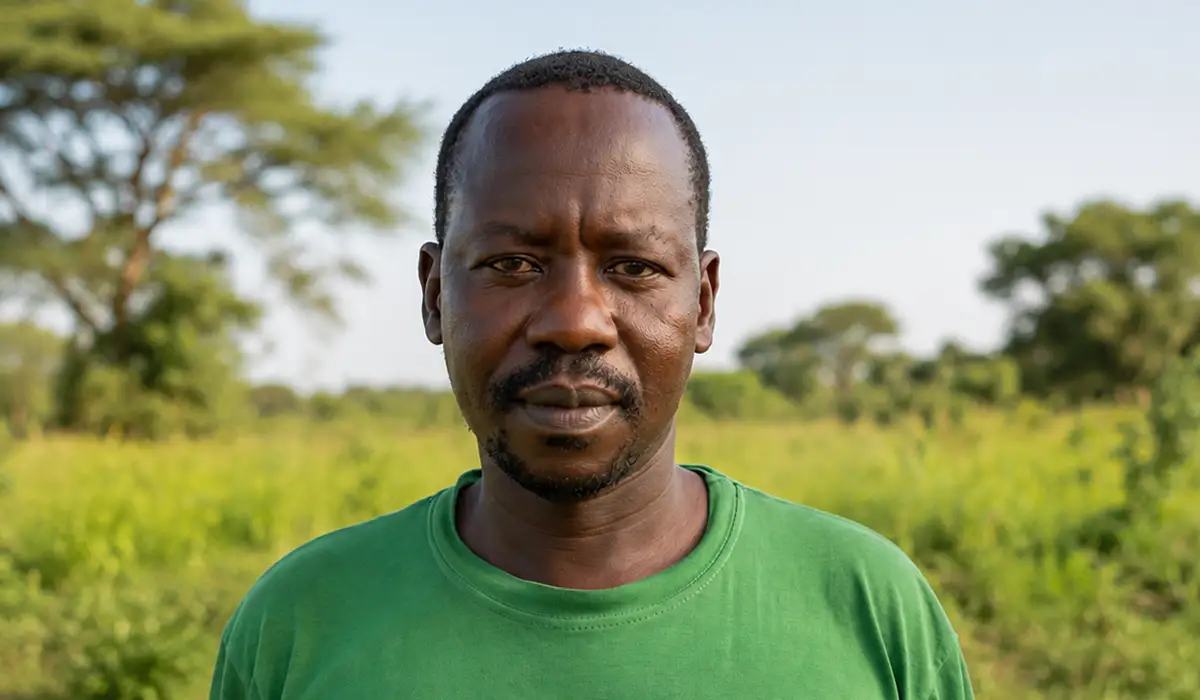
In Apyeta Parish, Lamwo District, maize is still grown, but for 46-year-old farmer Kenneth Akena, it is no longer the only crop he depends on. After years of uncertain returns from maize farming, Akena has added something new to his 3-acre land in Ogili Sub-County: rows of eucalyptus and teak trees meant to build long-term income alongside food production.
Through the IFPA-CD Woodlots Programme implemented by the Environmental Conservation Trust of Uganda (ECOTRUST), Akena planted 672 clonal eucalyptus trees and 672 Tectona grandis (Teak). While maize still occupies part of his farm, the trees now stand as a second line of income, one that grows slowly but is expected to pay more steadily in the years ahead.
“I planted these trees to get timber and poles for income,” Akena says. “People here buy timber at a good price. Before, I was planting only maize, but from what I have learnt, these trees have more return.”
For Akena, the change did not mean abandoning maize. It meant reducing dependence on it. Maize still feeds his household and supports short-term needs, but trees are now his long-term plan for stability.
“I still grow maize,” he says, “but I also wanted something that can support me in the long term.”
Learning a new way of farming
Akena is among hundreds of farmers in Lamwo who were trained under ECOTRUST’s community forestry model. For him, the biggest change came not from the seedlings he received, but from what he learned about how to manage them.
“We were trained on weed management after planting,” he explains. “We learned that weeds compete with tree seedlings for sunlight, water, and nutrients, especially in the first two years.”
Farmers were taught practical methods such as spot weeding and ring weeding, where only the area around each seedling is cleared instead of the whole garden. The idea, according to ECOTRUST, is to reduce labour while protecting young trees during their most vulnerable stage.
They were also trained in safe chemical use, including herbicides for weed control and pesticides such as Tamidoc, used to fight termites that often destroy young seedlings.
For him, these lessons turned tree planting from guesswork into a planned farming system.
According to Denis Emmanuel Oweka, ECOTRUST Regional Coordinator for West Nile and North East, the choice of tree species is based on both science and market demand.
Unlike ordinary eucalyptus that comes from seeds, clonal eucalyptus is artificially developed and grows faster. He says the key difference is time to harvest.
“If a normal eucalyptus takes about seven years, clonal eucalyptus can take between three to five years.”
The difference lies in the root system. While traditional eucalyptus develops deep tap roots, clonal varieties grow lateral roots near the surface, allowing faster absorption of nutrients from decomposing organic matter. This speeds up growth and shortens the rotation period.
This explains why many farmers prefer clonal eucalyptus. It also gives faster returns.
Alongside eucalyptus, farmers also plant Tectona grandis, commonly known as teak or Sudanese teak. Unlike eucalyptus, teak grows slowly but produces high-value timber.
“Tectona takes about 8 to 15 years depending on management,” Oweka says. “But it produces strong, high-quality timber.”
Farming trees as a business. For ECOTRUST and its partners, the message to farmers is that tree growing must be treated as a business, not a side activity.
Steve Amooti Nsita, Director of Technical Services at Havilah Company Ltd, says early results from Lamwo show promise.
“These trees have been good. Most of them are alive,” he says. “But farmers must treat this as a business if they are to benefit.”
He explains that the IFPA-CD Woodlots model is designed for pure tree stands, not mixed cropping.
He added that when trees are mixed with crops, the spacing changes and the number of trees reduces, hence reducing the economic return.
Under the project, farmers follow a 3 by 3 metre spacing, allowing about 450 trees per acre for maximum productivity.
Nsita adds that the benefits go beyond income.
“When you increase vegetation cover, you protect the soil and improve the local climate. The land becomes cooler.”
The hard work behind young forests
One of the most important lessons Akena learned is that trees require close attention, especially in the early years.
He learnt that if weeds are not controlled early, they take water, light, and nutrients from the seedlings, which explains why early management is very important.
Akena, among other farmers, were trained to weed regularly during the first two years using efficient methods like ring weeding to reduce labour while protecting growth.
They were also trained in proper planting techniques such as lining and pitting, which help ensure correct spacing and allow farmers to easily track the number of trees in a garden.
For Akena, this knowledge has changed how he views his farm.
“Now I know how to manage the trees properly,” he says. “Before, I didn’t understand these things.”
The IFPA-CD Woodlots Programme, funded by the World Bank and the Government of Uganda, is being implemented in 19 districts across northern and western Uganda. It aims to establish nearly 10,000 hectares of small-scale commercial woodlots.
For 27 years, ECOTRUST has worked with communities across Uganda to promote sustainable natural resource management, climate resilience, and livelihoods.