
Robert Kyagulanyi, Bobi Wine, former legislator and two-time presidential contender, has long implored Ugandan creatives to reject petty handouts from the State House and government. He instead routes for economic policies that enable sustainable livelihoods in the arts.
Yet, a scene now plays out with depressing regularity in Uganda’s creative industry. An artist, content creator, comedian, or TikTok influencer (any person notably in a celebrated position of influence and admiration) gains access to a powerful benefactor, the President, the First Lady, or a government bigwig, for instance, performs a flattering song or cracks a few jokes, and bang, he asks for money.
Upon receiving it or being promised it, they film the moment and post it online as “proof of hustle.” His followers applaud and get inspired. And begging, cum parasitism, plus all its other various mutants, infiltrates the general public as a quick popular economic activity itself, a sort of business, because “What monkey sees, Monkey does.”
This is not an industry strategy by any professional business or economic standard. Nor is it even “social capital,” as Bebe Cool would like us to believe. That activity is called parasitism (Luseke).
How the Fire Started
It goes without saying that Bobi Wine’s entry into politics, one way or another, supercharged the parasitic economy in Uganda’s creative sector, creating a political temperature so high that it changed the economics for every creative living within it. Here’s how:
The roots trace back to 2016. That year, President Museveni paid some of Uganda’s leading artists to compose a campaign song, Tubonga Naawe, praising his leadership.
As a result, artists involved faced strong backlash from infuriated music revellers. Fans retaliated with music boycotts and, during performances, hurled insults and even threw bottles at them. This pressure continued until some musicians apologised or at least acted contrite. Bobi Wine conspicuously refrained from the project. He, by word and action, portrayed himself as an opposition figure, as we can now witness, “…opposition becomes our position” was not a light phrase.
After Bobi Wine did so much to awaken artists as advocates for social justice, President Museveni’s brother, Gen. Salim Saleh, chief coordinator of Operation Wealth Creation, tightened his grip on the arts industry. Following the COVID-affected 2021 elections, Uganda’s creatives (musicians, comedians, promoters, and producers) began making the long journey north to Gen. Salim Saleh’s residence in Gulu for financial support to recover from the pandemic’s economic “punch.”
The spectacles they caused there became so embarrassing that Saleh snapped. “Musicians, I am tired of you. You lack organisation, cohesion, and training.” A man who, as Bobi Wine noted, “can’t even sing one musical note,” demonstrated that he could control a whole sector of the arts industry.
To this event, Bobi Wine responded by directly targeting the relationship between creatives and State House: “I warned you (artists), these people will make you beggars, and you’ll end up being despised… They are oppressors, exploiting local Ugandans who have supported you because your songs resonate with their struggles.”
He added, “I deployed Hon. Hilderman to collect your thoughts and ideas on the copyright law. Many of you wonder why the Nigerian entertainment industry is booming; the logic is clear, their artists are protected by copyright law.”
Yet, the begging never stopped; it simply relocated.
Jazz with Jajja: The Rebranding of Begging (Luseke)
In 2026, a new begging platform for creatives evolved: Jazz with Jajja. These are intimate sessions hosted by President Museveni’s daughter, Natasha Karugire, bringing together content creators, journalists, digital entrepreneurs, and influencers for “candid conversations” with the president about the creative and digital economy. The packaging is better. The PR is sharp. But the underlying architecture is identical to Gulu: access to power, exhibition of flattery, and the pursuit of favours.
Ugandan YouTuber Isaac Daniel Katende, alias Kasuku, has become the poster child of this new dispensation, not entirely through his own fault, but through the relentlessness of his performance. He first featured on the platform on 04 January 2026, days before the 2026 Uganda Elections, where his direct questions about the digital economy drew wide attention. He returned for a second session at Kisozi ranch, yet this time, he raised the stakes. He reminded the President of a previous monetary promise, noting that since their last meeting, people had been stopping him on the street saying, “The President gave you our things [Money].” Then, in an emotional show, he described himself as an orphan and requested that the First Lady personally adopt him!
Lil Pazo, a Ugandan musician, had pre-announced his intentions months back, telling Kasuku, “When God gives me a chance to meet the President, I will look him in the face and tell him to give me some money.” He kept his word. When that moment came, he told the president plainly: “I would like you to give me some money because my well-being is not great.” His plea was preceded by a performance of a praise song dedicated to Museveni. The classic sequence: sing, flatter, beg (a sequence that did not work well for OS Suuna during the Gulu era).
Yet these folks weren’t the only ones in attendance. Hundreds of fellow creatives in attendance attempted to frame their intentions as professional industrial “ideas,” though every presentation eventually dissolved into a plea for help. Observing Museveni’s expressions, he appeared amused by the spectacle of their desperation. This man advises his advisors, so it’s pointless to try advising him.
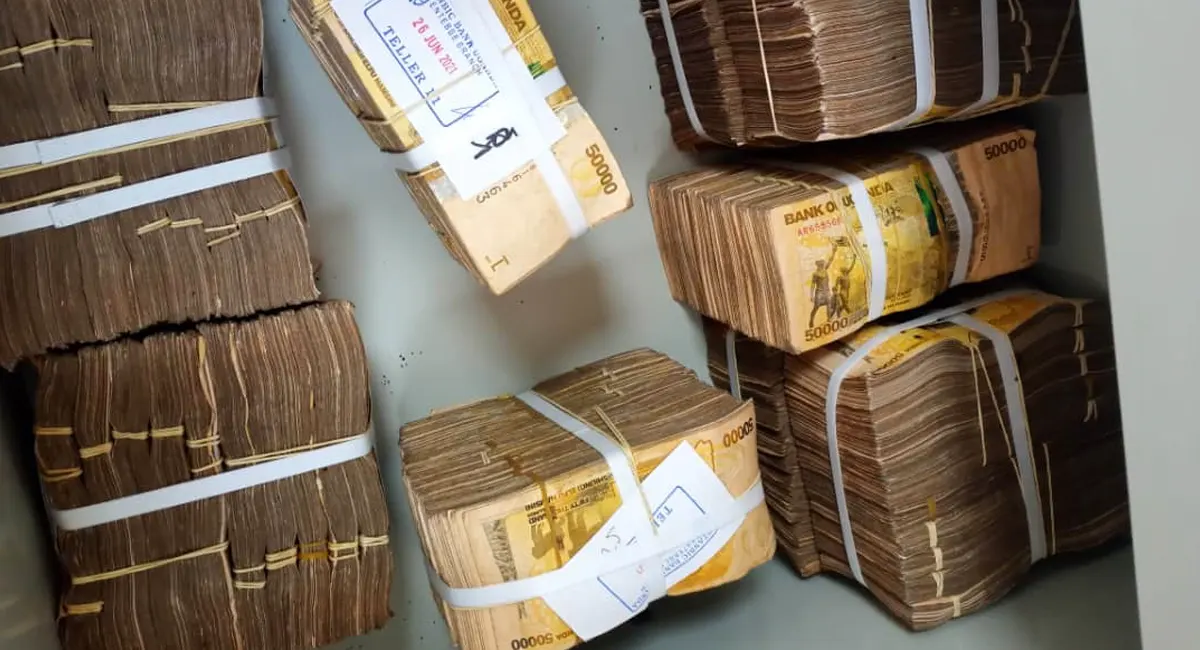
He did make a gesture, though: he announced a commitment of UGX 5 billion to the content creators’ SACCO. But the envelope, true to form, created more division than it resolved. They allegedly split over the pledge almost immediately, driven by suspicion and “beggar-esque” hunger.
In Uganda, when people say “creatives,” they mostly mean musicians, as if photographers, writers, designers, and filmmakers are just there for decoration. Yet, the crisis of creative income is not musicians-only. The Luseke economy thrives in the vacuum created by a broken intellectual property system. When the law offers nothing and the industry has no organised power to demand change, the envelope becomes rational. It is a shameful rationale, but a rationale nonetheless.
The Bill That Could End Begging (Luseke Economy)
March 17, 2026, the Parliament of Uganda approved the Copyright and Neighbouring Rights (Amendment) Bill, 2025, something Bobi Wine had implored artists to be aggressive about from the start. The legislation directs that originators of creative works, including musicians and authors, receive better remuneration for their productions.
The law is not a gesture; it is architecture. One of its most significant provisions is the introduction of mandatory written contracts for all copyright transactions, and payment of royalties from radio, TV, and public places where music is commercially consumed to creatives. Payments are to be processed through systems under the National Payment Systems Act to ensure transparency.
The law proposes fines of up to UGX 50 million and up to 10 years of imprisonment for various copyright-related offences to deter piracy. Critically, the Bill widens protection to literary works such as novels, plays, and encyclopaedias, meaning the writer and the playwright finally have a seat at the table.
The law, however, isn’t without imperfections. For instance, the Attorney General flagged the provision that caters for AI-generated content. On top of that, Geoffrey Ekongot, Executive Director of the Uganda Musicians Association, warned that the phrase “net revenue” in the caller ringback tone provision could allow telecom companies to deduct many costs before calculating the artist’s share, and the artist’s share might be dwindled by puffed-up administrative costs.
These are legitimate concerns, but they are the kind of issues that organised, informed creatives can push to fix in committee rooms and regulatory consultations, not in presidential residences. The bill now awaits presidential assent; the same president whose home has become a stage for creative supplication must sign into law the very instrument that could make that supplication unnecessary. There is a certain bitter poetry in that.
Conclusion
The passage of this law was not a gift. Just days before its passage, the bill appeared fragile. During the debate on March 12, remarks by Speaker of Parliament Anita Among put Clause 9, the bill’s most consequential provision, under heavy scrutiny. What followed was rapid mobilisation. CMOs issued joint statements, and industry leaders wrote directly to the Speaker. Hours before the final sitting, a closed-door meeting was convened with industry stakeholders and government legal officials to make their case.
That, not Kisozi, not Gulu, and not a flattering song, is what secured the most important piece of creative legislation in Uganda’s history: Organisation. Presence. Argument.
The begging bowl and the royalty statement are not equally dignified instruments of income. One shrinks you before power; the other places you in a legal and commercial relationship with the market. Bobi Wine once said that many artists, after discovering the power of their platform, decided to exchange it for money. The Copyright Amendment Bill might be the answer to that dilemma, not because it resolves the tension between art and commerce, but because it refuses to make that tension a choice between dignity and survival.
The question is no longer whether the law exists. It does. The question is whether the same people who queued for envelopes will show up when it is time to enforce it. Either they remain supplicants in the president’s court, a footnote to political pageantry, or they become rights holders in a serious creative economy, paid by contract, by statute, and by the merit of their craft.