
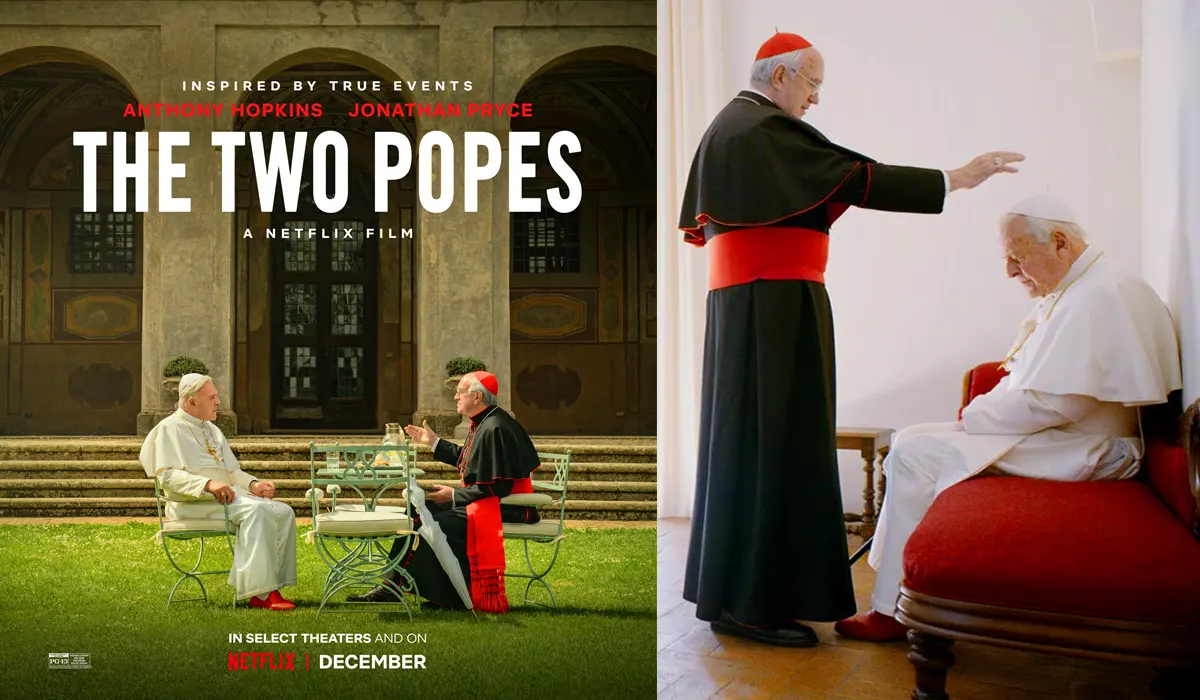
The Two Popes (2019) is clear about its premise from the start. Set behind Vatican walls, the film follows Pope Benedict and the future Pope Francis as they confront their past decisions and try to find common ground for the Church’s future. You already know how their story ends. Yet the film still finds ways to keep you engaged.
With earlier work circling on power, guilt, and moral tension, Fernando Meirelles was a natural fit to direct this film. The fact that he is Catholic matters and helps explain how the film treats faith, doubt, and ritual not as spectacle, but as lived experience.
Anthony McCarten writes this film’s screenplay in a dialogue-heavy style, one that will feel familiar if you have watched Darkest Hour (2017) and his later biopics. There is a lot of talking in The Two Popes (2019), but the careful attention to surrounding visuals sustains its pacing.
Director Meirelles thoughtfully handles the film’s space and composition, sometimes using a loose, handheld camera style, while real archival photos at key moments give the film a documentary feel, blurring the line between staged drama and recorded history.
Another observation is how the two conclaves are shown in condensed form, yet they retain their significance. The summarised scenes carry a distinctly Catholic atmosphere: cardinals move in unison into the Sistine Chapel, votes are cast under Michelangelo’s Last Judgment with careful attention to detail, and the silence, footsteps, and vows all contribute to the film’s aura. Even though the events are shortened, nothing feels rushed or hollow.
Although the film could have entirely worked with the Vatican’s traditional languages, The Two Popes leans on English for most exchanges, mainly between Pope Benedict and Cardinal Jorge Bergoglio. Subtitles are recommended, both for the accents and because the film naturally incorporates Spanish and occasional Latin. As a dialogue-driven film, keeping subtitles on ensures better comprehension.
Despite the title, this is largely Pope Francis’s story. Jonathan Pryce carries the film as Jorge Bergoglio, with Juan Minujin filling in his younger years. Pryce gives you a man shaped by regret, humour, and quiet conviction. Flashbacks to Argentina by Juan deepen his portrait without overwhelming the present.
If there have to be tears, let’s make them tears of joy
Anthony Hopkins approaches Pope Benedict with calm precision, capturing the weight of criticism, the loneliness of the office, and the burden of tradition. His performance avoids caricature and comes across as a thinker grappling with the limits of his role rather than a villain guarding power.
When no one is to blame, everyone is to blame
The film also offers a rare picture into the Pope’s life beyond prayers and formal duties, watching football, playing music, and strolling through gardens. These moments humanise without trivialising, expanding your view of the papacy without breaking it.
In this film, attention to detail is almost a second language. Bergoglio’s simple shoes, his rosary, and modest attire reflect the life he chose and maintained even as Pope. These small choices matter, quietly hinting at Pope Francis’ character without ever spelling it out.
Netflix deserves credit on this one: the film avoids crude language and cheap provocation, respecting both its subject and its audience. The direction and screenplay draw clear boundaries and stick to them, a rare approach in many Netflix films about religion. The story is also easy to follow, even if you don’t have deep knowledge of Catholic doctrine.
So, is The Two Popes (2019) still worth watching in 2026? Absolutely. This quietly moving film about Pope Francis’ election and inner life will long hold its place as a rare success, functioning as history, character study, and reflection on leadership, and could even be called a gospel film, told through the life of Jorge Mario Bergoglio.