
Every time a new AI image generator or video tool launches, the same prediction resurfaces: “AI is coming for designers’ jobs.” But that may be the wrong conversation entirely.
The real shift isn’t that generative artificial intelligence has become more creative than humans. It’s that AI has become good enough to produce average creative work in seconds. And that changes everything.
For years, much of the creative industry survived on execution rather than imagination. Beautiful mock-ups, trendy fonts, polished presentations, cinematic transitions, and endless design jargon often masked ideas that weren’t particularly original. A project could look impressive without saying anything memorable.
We’ve all seen it: the logo that follows every current trend but has no personality. The social media post with flawless gradients yet no message worth sharing. The motion graphics reel is packed with smooth transitions but lacks a story. The brand identity is presented with dozens of stylish mock-ups that cannot explain why the graphic design exists in the first place.
Today, anyone can generate a clean poster, remove a background, animate text, create illustrations, or design social media graphics with a simple prompt, completing tasks that once took hours in minutes.
Consequently, if your value lies solely in operating software, AI will inevitably reduce the demand for that skill alone. But true creativity has never been about knowing which buttons to press; it is about the vision behind them.
The designers who will thrive are not those competing with AI; they are those directing it. They understand strategy before style, storytelling before decoration, and communication before aesthetics. They ask better questions, develop stronger concepts, and create work that connects with people emotionally.
While AI can generate stunning visuals, it cannot replace lived experience. It cannot truly understand the deep cultural nuances behind a Ugandan campaign, the emotional heartbeat of a non-profit’s mission, or the human insight that transforms a simple poster into a movement. Furthermore, AI cannot build trust with clients, interpret vague, abstract ideas, or guide a creative team toward a shared, inspired vision. Those remain deeply human responsibilities.
The future of design belongs to creatives who combine imagination with intelligent tools. Designers who learn prompting, automation, motion systems, and AI-assisted workflows will work faster than ever before, but speed alone will never be enough.
The true competitive advantage is original thinking. AI has not lowered the ceiling for creativity; it has simply removed the floor. Average work is now automated, making original ideas, meaningful storytelling, strategic branding, and bold visual thinking more valuable than ever.
The question is no longer whether AI will change the creative industry; it already has. The better question is: How will you use AI to become a more valuable designer, motion artist, or creative thinker? Because the future won’t belong to the people who fear AI; it will belong to the creatives who know how to make AI amplify their vision rather than replace it.
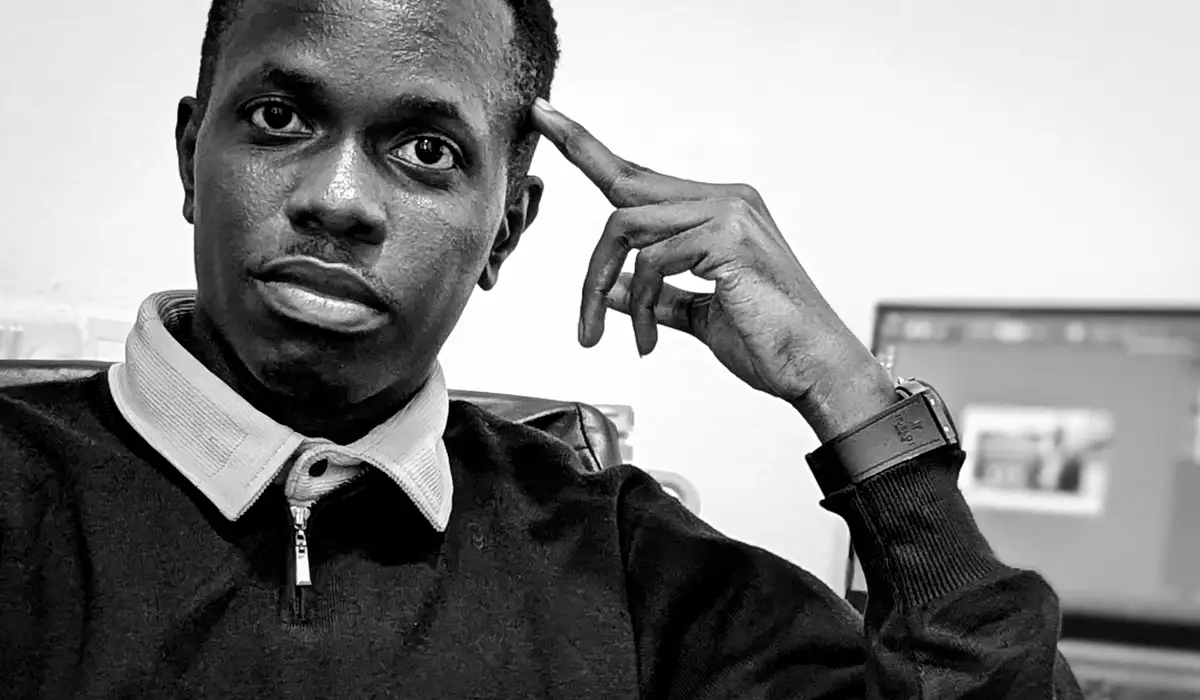
Written by Andrew Ssuuna, a creative designer at Capital One Group and photographer at Six Sense Studios.