
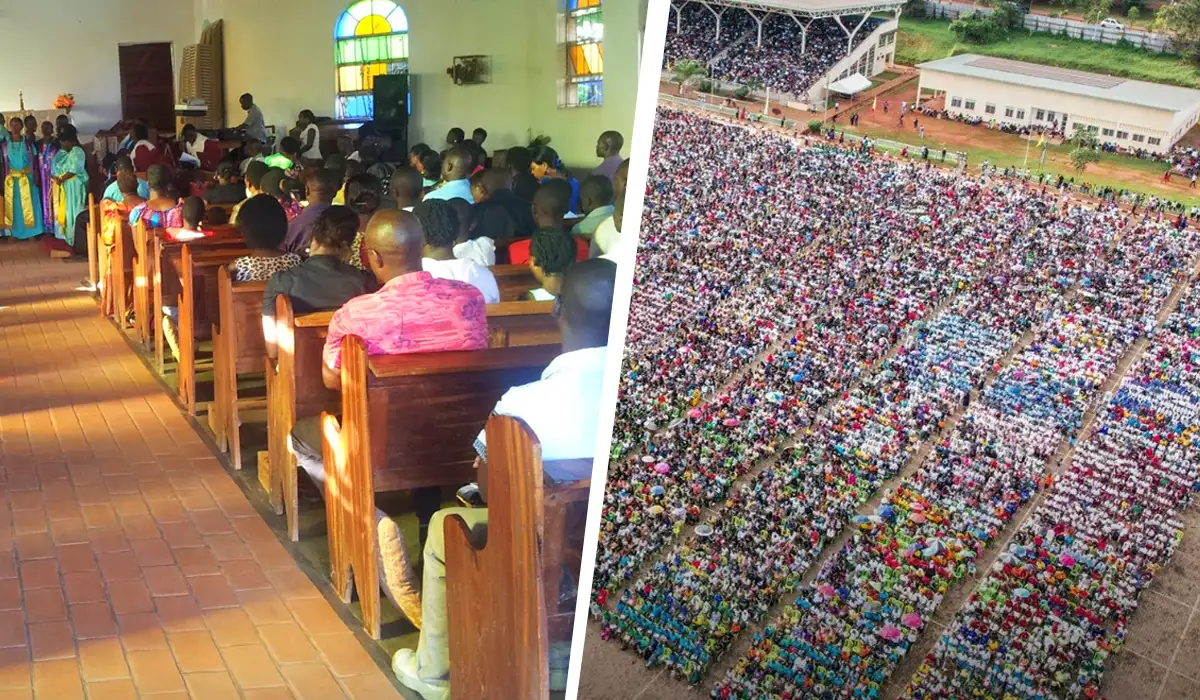
On any given Sunday morning, two kinds of people head to church. On one hand, thousands stream into a massive auditorium or a huge field with glowing screens, intentional lighting, live-feed cameras, and an atmosphere buzzing with energy. On the other hand, wooden benches creak as familiar faces greet one another by name. The choir warms up in harmonies everyone already knows with the expectation of a simple, predictable, and deeply comforting service.
Both gatherings are called church, yet if you are to ask members of either church, they will describe different experiences. This begs the question: Have you ever wondered why large churches seem to draw youth, while smaller churches often hold the loyalty of older generations? Is it just vibe and hype versus intimacy and familiarity, or is something deeper at play?
First, what exactly is a church? Britannica defines a church as a body or organisation of Christian believers. A church is also defined as the structure where believers gather to worship and pray. The word ‘Church’ comes from the Greek word ‘ekklesia,’ meaning a gathering of people or community.
That said, this conversation is less about church size and more about what people seek when they step through those doors.
What’s the Deal with Size Anyway?
A mega church typically draws a congregation of over 2,000 people every Sunday. In Uganda, Phaneroo Ministries Kampala, Miracle Centre Cathedral, Worship Harvest, and Watoto Church are defined as mega born-again churches. These churches are often highly organised, media-savvy, and are known for having multiple branches. For these churches, it is not unusual to have structured growth strategies and strong branding, and even a visible public presence.
Although many widely attended churches seem to fall under this category at first glance, it’s worth noting that not every large congregation fits into the mega church model.
For example, traditional parish structures, especially within long-standing Anglican or Catholic systems, may draw large numbers but operate differently; often community-anchored and liturgical rather than strategy-driven. In many cases, a large congregation may indicate that “St. Andrews Church” is located in a community dominated by Anglicans or Catholics.
At the other end are local churches; smaller congregations under 700, often deeply rooted in specific communities, the omuntu wawansi. Many meet in modest buildings, sometimes makeshift structures (Kiwempe & Mabaati), and are known for conducting services in local languages. Their strength is not spectacle but familiarity.
In megachurches, growth is visible and measurable. Increasing numbers are interpreted as impact, reach, and effectiveness—expanding the Kingdom of God and spreading the Gospel of Christ. Proof that strategies are working, goals are being achieved, and the men of God are doing their jobs right. This, however, invites criticism. Large churches are usually seen as superficial, brand-focused, and impersonal. Critics question whether true community can exist among thousands, and wonder whether visibility in megachurches sometimes replaces depth.
Megachurches in Uganda, such as Phaneroo Ministries, Elvis Mbonye’s Zoe Fellow Ministries, and Miracle Centre Cathedral, are often labelled as cults, money traps, and churches for the well-to-do Christians. Statements such as, those are just superficial Christians…, people at the big church just want to blend in and don’t want to serve…, they can’t possibly have true community in a church that big…, and pastors of large churches are self-centred and just want to build a kingdom and name for themselves.
On the other hand, small churches like Deliverance Church Uganda and Church of Uganda are often described as intimate. These specific churches may have numerous branches across the country; however, not as much energy is put into advertising and increasing numbers. Additionally, each branch has its own intimate number of members who know each other front and back. They know the choir’s set list by heart, one’s absence is noticed, and your name is remembered even without a blood tie to the senior Pastor. These local churches are defined by the familiarity of the congregants with each other, many of whom have been to each other’s houses to pray over a family matter or speak about church issues over tea and bread.
Why Youth Gravitate Toward Megachurches
Church choice is rarely accidental. It is shaped by routine, familiarity, and the current stage of life. Younger Christians often prefer megachurches simply because it is all they have ever known, their families have attended the same church for years, and it becomes theirs too.
To younger Christians, church is not only about doctrine but also identity. Young people who are still exploring themselves often gravitate towards spaces that feel expressive and alive: energetic music, a charismatic senior pastor, polished production and sermons that address contemporary issues in modern language, a typical mega church.
There is also the undeniable social dimension. Large churches offer visibility, which can translate into networking, paid roles within church structures, and, at times, social status. Attending a megachurch can feel like being part of something influential and culturally relevant.
Why Older Generations Remain Loyal to Local Churches
For many older congregants, church is not only an experience but a community, one that turns strangers and familiar faces into family. It is where children are taught and raised within shared social and faith values, including dress codes, weekly Bible studies, and long-standing church routines, that are often perceived to be less common in megachurch settings. In these local churches, traditions are preserved, and faith is practised within a stable social structure built over years, sometimes decades.
In smaller congregations, participation feels personal. Attendance is noticed, announcements are communal, and being known often translates into being cared for. This visibility is not interpreted as pressure but as belonging.
Some worshippers remain tied to local churches for family and sense of heritage, the ‘we are Anglicans/Catholics,’ since leaving “the family church” can feel like severing roots.
Others gravitate towards local churches because they see a focus on spiritual depth rather than growing the size of the congregation. For many older congregants, worship before live-stream cameras for live television and YouTube, surrounded by faces that change every week and may never be seen again, feels distant and impersonal.
Many argue that faith in smaller local churches is not something to be consumed but lived, and perceive an absence of this lived faith in bigger churches.
Is the Church Becoming a Consumer Choice?
One of the most interesting patterns emerging from public opinion is that people do not always choose churches based purely on doctrine. Many believers choose their places of worship based on how they make them feel, how they fit into their lifestyle, and whether they reflect the version of themselves they are becoming or trying to preserve.
In Uganda, megachurches are seen as symbols of growth, ambition, and visibility, whereas local churches convey stability, rootedness, and accountability.
While this is not necessarily a matter of right and wrong, it may simply reflect generational tendencies: younger worshippers often seek exploration, while older worshippers often seek consistency. Even so, both mega and local churches have noticeable congregations of young and older members.
Megachurch vs Local Church?
Despite public opinion in Uganda leaning towards local churches, worshippers differ in what they seek: some value intimacy and deep connections, while others are drawn to energy, scale, and being part of something expansive.
Perhaps the question shouldn’t be which model of church is better, but what you, as a believer, truly need in your current season of life to grow, feel at home, and be spiritually fulfilled.
Be part of this conversation and share your thoughts below.



1 thought on “Megachurches vs Local Churches in Uganda: Which One Truly Feeds the Soul?”
I tend to disagree, God’s laws do not wait for you to be at that stage when you “feel like”. They are there and they are permanent. The smaller more intimate churches nurture youth into responsible Christians which is not the case with the mega churches – so called houses of God which have been turned into businesses. Stay away from those fake pastors!