
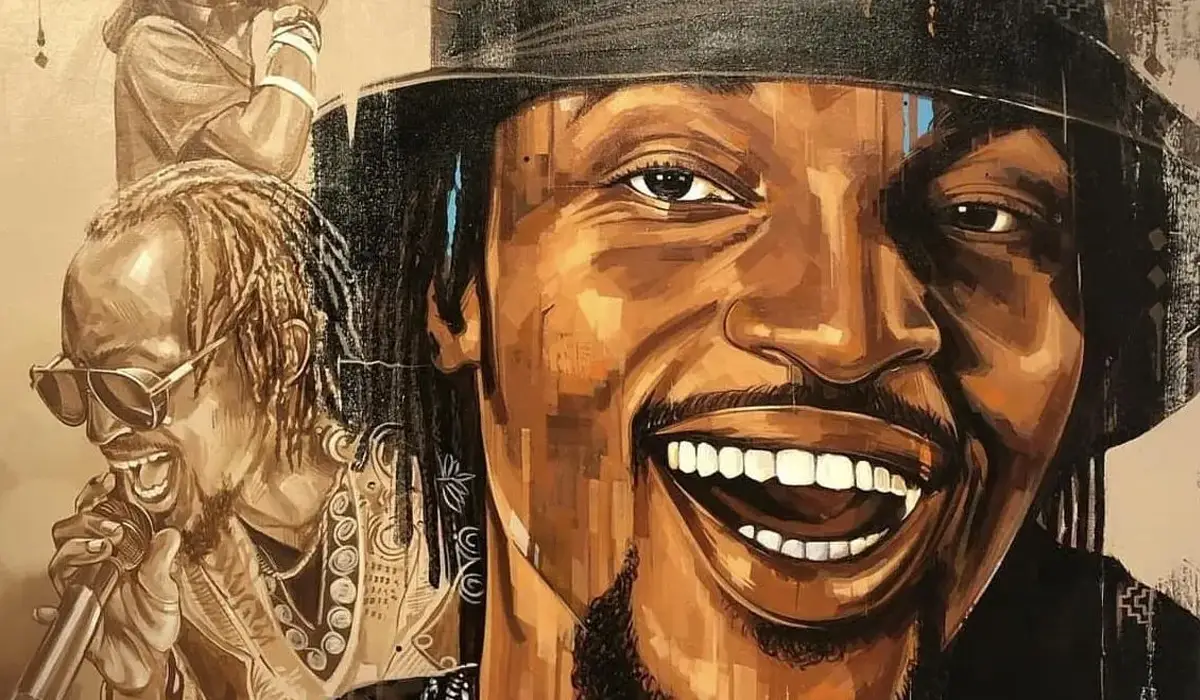
Mowzey Radio, the second half of Radio and Wesel, wasn’t just Uganda’s most beloved voice; he was a monster writer. He spent his childhood listening to Fred Sebatta and inherited his writing style, dramatising feelings rather than narrating them. But where Fred Sebatta had 15 minutes to build a full scene, Radio often had one line. He made you feel what Sebatta would make you see. He did this with his lyricism, poetry and strong imagery.
When he asks Jennifer for a certain dance she performed at Julie’s wedding, as well as to sing Christina Aguilera’s song, it’s hard to understand that Julie is a made-up character and that Christina is a real person. And when he shouts a girl’s name like a Vuvuzela, you’re reminded of the World Cup in South Africa, but when he mentions Tshabalala, your mind can’t figure that out.
Think of Mowzey Radio as a poet, lyricist, mind-painter, manipulative scriptwriter and more. He drew something in your mind, and it made you cry or smile.
Radio delivered deep lines with magic that lived in the gap between what he said and how he sounded saying it. He was a trained community psychologist who had the skill to bring out of his listener all the emotions he wanted. Listening to Radio Mowzey and crying wasn’t accidental; it’s something he planned the moment he put his pen to paper, as a professional film scriptwriter would. See these lines;
#1. Zuena
“Unapendeza sana sana… Unaniumiza sana sana” (You are so lovely… you hurt me so much)
The intention of that line seems to have been creating a rhyme (-ndeza, -umiza), and this is where most writers would miss it; they want to rhyme but forget meaning and emotion. That line sets up the song’s whole engine in one breath: beauty and pain arriving together, inseparable. Then he escalates into something few songwriters would risk, trying to measure love using a measuring machine: “Zuena, lwaki tonteka ku minzaani… noopima nolaba akwagala y’ani” (Why don’t you put me on a scale and measure who loves you).
The line “Oli nga ekyuma ekipima obudde obwembela” (you are like a temperature-measuring machine) isn’t necessarily a romantic cliché; it’s a deliberate refusal to sound plain. An amateur writer would say, you are a thermometer! But to a common Ugandan who has ever had their temperature tested, he wanted to show that Zuena is like that device they put on your body to test your ‘hotness’; most Ugandans are not good at pronouncing ‘th,’ so he saved their day.
That’s the same instinct John Donne used centuries ago, comparing love to a compass or an astronomical instrument: forcing an emotional truth to justify itself in the language of precision.
The line, “Ku countdown y’omutima gwange gwe ali ku number emu” (on the countdown of my heart, you are at No.1), a radio listener understands what a countdown is and what a number one song on a countdown feels like.
#2. Nyambula
This breakup song was, in a sense, a quiet jab at Jose Chameleone. Many Leone Islanders remember Chameleone as the demanding boss who would order his protégés to remove his shoes for him, barking, “Nyambula engatto!” (Take off my shoes!), which is how he earned the nickname “Nyambula” within the crew.
Radio took that inside joke and turned it into a genius disguise: although the song is titled Nyambula, in reference to Chameleone, he actually pronounces it Nyambura throughout, reshaping it into what sounds like a breakup song about a Kikuyu girl named Nyambura. The real meaning hides in plain sight, buried inside a name that sounds almost, but not quite, like the joke it’s actually built on.
“Bwewakaabanga nga nze gwokaabila, nga lwokubye enddulu wuuwi nzilukilira” (When you cried, it’s me you were crying for. When you raised an alarm, it was me who responded) is nearly non-metaphorical; it reads almost like testimony. Radio is describing himself, and likely the other Leone Islanders, as the ones who always showed up whenever Chameleone got into the fights he was known for picking. But the line also works as a broader truth about relationships: in most partnerships, one person ends up carrying the weight, always the one to step in, always the one to fix things. That person is usually left heartbroken in the end, because when their effort goes unnoticed, the other party eventually walks away.
“Naye nondekaawo, ogenda webigula n’abazungu. Abalina sente mpulira balingamu n’obubundu” (You left me alone and went running around with loaded foreigners… they had some guns too). On the surface, this line exists mostly for the rhyme (-zungu, -bundu), but it does real work underneath. It paints the picture of someone trading loyalty for a “high life” with foreign men, and the mention of guns adds a sting of helplessness: the image of a white man with a gun taking your girl, and there being nothing you can do about it.
#3. Where You Are
Radio was good at language mixology: mixing Luganda, English, and Swahili.
“Rohoni unanitesa kishenzi” (inside my soul, you torture me mercilessly) carries the raw emotional charge, and the song immediately code-switches into English for the plainer request, “find a place we can go… lost in your arms.” The Swahili carries the suffering; the English carries the asking. Radio may never have consciously thought of it in these terms, but his instinct, his genius, working beneath deliberate thought, arrived at the same result. And as listeners, we can still notice it, even if he never mentioned it anywhere.
#4. Ngenda Maaso
What happens when you go after a man with a thousand talented, poetic ways of hitting back? You end up on the receiving end of his pen. Chameleone, New Vision, and Bebe Cool all felt the sting of Radio’s writing in this song. “Elinya lyange olisiize enfuufu. Ogambye abantu ebyenyanja byange byentunda bivuundu” (You have smeared my name with dust, you tell people I sell rotten fish) and “Amagoba gange gakukwasa ensaalwa so nga maanyi gange lwaki oyagala okufuna amangu” (my profits make you jealous, yet it’s my hard work. Why do you want to make quick profits?) were both aimed squarely at New Vision, who Radio and Weasel accused of publishing false stories about them.
He used the simplicity of a fish business to depict just how envious the music industry was of Goodlyfe.
The honest context behind it: when Goodlyfe rose to fame, it stirred real resistance from industry gatekeepers blocking anyone from climbing past a certain point. Reportedly, the media itself had been influenced by powerful industry forces determined to hold back rising acts. Goodlyfe’s momentum caused such a stir that they ended up in direct conflict with Vision Group, Ange Noir (now Club Guvnor), DJ Shiru, Straka Mwezi, and other established gatekeepers of the scene.
In fact, Goodlyfe wrote separate songs as direct responses to specific rivals: Kiduula aimed at Ange Noir, Bakasitoma aimed at New Vision, and Camilla, Sitani, and Lwaki Tokula aimed at Chameleone, who, in Ngenda Maaso, is the target of the line “banoonya ng’ensowela” (they hunt for me like a fly), a reference to Chameleone reportedly hunting down and confronting Radio and Weasel in clubs. Other unspecified rivals were addressed in songs like Talk and Talk. Though Radio and Weasel were, on the surface, mainly known for love songs, they clearly made time to answer every attack thrown their way.
#5. Enyimba Z’omukwano
This is one of Mowzey Radio’s most emotionally heavy writings. “Okwagala nabwo bulwadde olukukwatako tebiwona, mazima obelera ddala ng’eyalwala kokolo okulemala” (Love is like a disease that never heals; it’s like a cancer that cripples you) is about as far from a typical love song as a love song can get, and then he breaks the fourth wall entirely: “Enyimba z’omukwano zinyiiza. Ziwanawana nyo abagalana” (I hate love songs; they praise lovebirds.) That line is remarkable.
Enyimba z’omukwano is almost a direct echo of Ne-Yo’s So Sick, another heartbreak song where the singer admits he is tired of hearing love songs because they only remind him of what he lost, even though he sings love songs himself. Both artists use the same trick: turning the song into its own confession.
The line “Nze nebwenebaka n’enema okuzukuka” (even if I sleep and never wake up) reads less like poetic hyperbole and more like exhaustion with being alive inside the feeling of love. He made it appear like he was helpless and vulnerable to the point of wanting to die, the same way he did in Nkwagala when he said: “Esaawa bweliba etuuse ng’owulira okooye okundaba onyambanga mukwano n’ongamba nenoonya ekyokola” (In the moment when you feel tired of me, I beg you to let me know so that I look for what to do). The emotion that line engenders is that what he would do might as well be committing suicide; and since no one wants to be the cause of someone’s suicide, the person he was addressing would make sure he never gets tired of him.
#6. Machozi
“I am standing by the roadside hoping you’ll be passing by, come see me.” Every boy has stood at some roadside waiting for his crush to pass by.
#7. Bread and Butter
“Bread and butter” is an idiom that means a livelihood. So, this meant that the girl was Radio’s livelihood.
But here is the catch. Radio had to make this line work for listeners unfamiliar with the English idiom, many of whom didn’t even know what butter was, since it isn’t common in most Ugandan households, or at least they don’t know it’s called that. So, he translated it into Luganda as “Oli mugaati gwa butter,” literally (You are bread with butter). That direct translation carries a different meaning altogether. In English, the phrase is about necessity, something you can’t do without.
In Luganda, the meaning shifts to taste and sweetness; bread smeared with butter is simply delicious, so the line becomes “you are as sweet as bread with butter” rather than “you are essential to my survival.” That shift is exactly why local fans connected with the song so strongly: most weren’t decoding an idiom about necessity; they were hearing a simple, relatable compliment about sweetness.
“Olinga enkuba etonya ekiro ku mabaati” (You are like rain that rains on the roof at night) means her presence gives him comfort in a quiet, steady way, like the calming, repetitive sound of rain at night when everything else is still.
“Oluusi ndoota nenkulaba nga otudde awo kumpi n’eddinisa, obufananyi nembukuba, negative neenzooza” (Sometimes I dream and see you seated by the window, I take pictures in the dream and develop the negatives) means he thinks about her so often that even his dreams are detailed and specific, not a vague image, but her in a clear setting, by the window. He treats the memory as worth preserving, the way you’d develop a photo to keep it permanently, saying the dream felt real and important enough that he wanted proof of it afterwards.
“Olina omusango gw’okuwoza mu kirooto lwaki wansooza” (You have a case to answer as to why you jeered at me in the dream) means that in the dream, she mocked or laughed at him, and he’s now confronting her about it as if it really happened, even though it only took place in his imagination. Treating something imaginary as a real offence is his way of joking about how much the dream affected him; he was bothered by something she never actually did.
Click here to read Part 2