
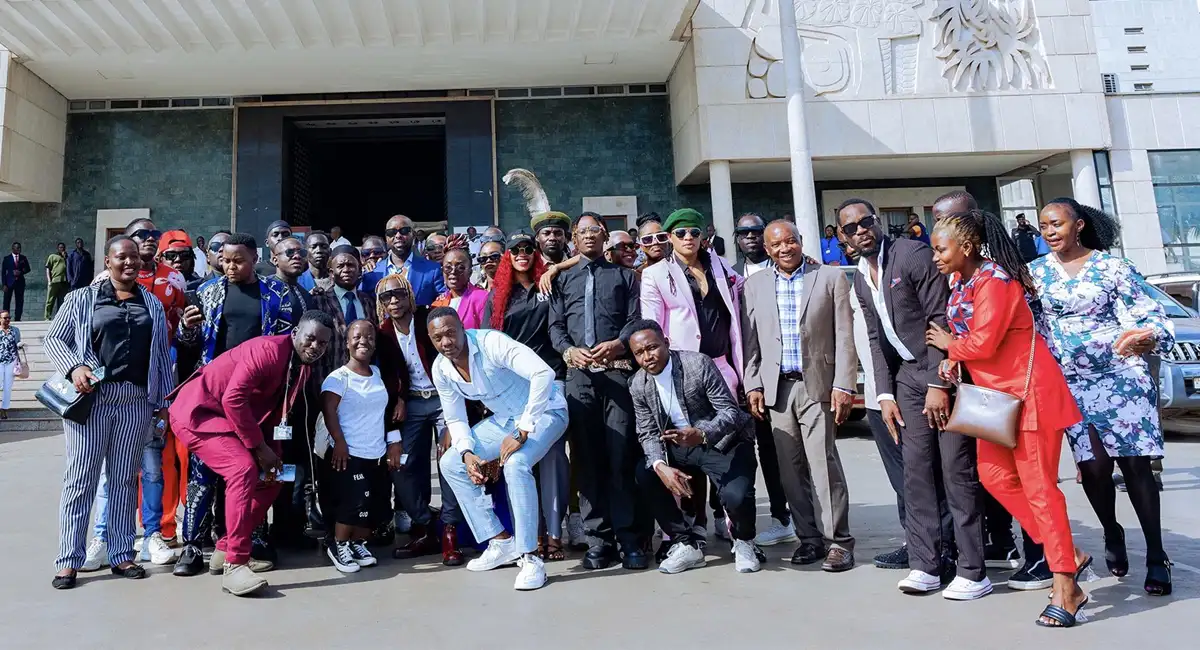
Uganda’s Parliament passed the Copyright and Neighbouring Rights (Amendment) Bill, 2025, on March 17, 2026, and creatives across the country erupted in celebration. After years of advocacy and lobbying, and a last-minute push that saw industry leaders converge at Parliament, the law cleared its final hurdle. Artists cheered. Eddy Kenzo called it a life-changing moment. And they were not entirely wrong.
But beneath the celebration lies an uncomfortable truth: a law, however well-intentioned, is only as powerful as the clarity it brings to every relationship it touches. Uganda’s new copyright framework does important work, but it leaves several rooms unlit, agreements unmade, and questions entirely unanswered. In this article, Mwesigwa Joshua attempts to ask those questions, plainly and directly.
The State of Uganda’s Copyright Law
Uganda’s legal protection for creative works is rooted in the Copyright and Neighbouring Rights Act of 2006, the first major reform of a framework that dates back to a 1964 Act inherited from the United Kingdom. In simple terms, copyright means the legal right to own and control a creative work, a song, a book, or a painting. Under Ugandan law, the moment you write a song or record it, that song belongs to you automatically. You do not need to register it anywhere for it to be yours. Registration with the Uganda Registration Services Bureau (URSB), which handles trademarks, company names, and intellectual property, is optional, but can strengthen your legal position if someone disputes your ownership.
The 2025 Amendment Bill, still awaiting presidential assent at the time of writing, introduces sweeping reforms. It reduces the period for musicians to reclaim sold rights from 50 years to 20 years. It mandates written contracts for all copyright transactions, a seismic shift in an industry historically dominated by handshake deals and verbal promises. The amendment bill introduces a 70/30 rule on Collective Management Organisations (CMOs), requiring that at least 70% of all collected revenue be distributed to rights holders, with a maximum 30% retained for administration. It formalises a revenue split for caller ringback tones (CRBTs), those short clips that play when you call someone’s phone, where authors and performers each receive 30% of net earnings. And it establishes clearer digital enforcement tools for unauthorised online use.
What is Missing in the Law?
Critically, the new law should require that before copyright is formally registered at the URSB, the work in question must first be published in the Uganda Gazette, the government publication where legal notices appear. This is a vital safeguard. Publication in the Gazette gives every interested party, a co-writer, a producer, a previous rights holder, the opportunity to see the filing and formally dispute or contest ownership before it is registered. This step is not a bureaucratic formality; it is a firewall against theft. In Uganda’s music industry, it’s common for an artist to quietly submit a song to URSB while conveniently omitting the names of the songwriter or producer who contributed to it. The Gazette requirement would give those parties a fighting chance to assert their stake before it is too late.
What are Neighbouring Rights?
Neighbouring rights are the legal entitlements of the performer and the producer of a recording, separate from the songwriter’s rights.
Simple definition: Neighbouring rights = the rights of the performer (the artiste who sang the song) and the producer (who recorded it), separate from the rights of the songwriter (who wrote the melody and lyrics).
Neighbouring rights royalties are generated when a song is played on radio, television, or streamed online. The broadcaster pays a license fee, which is split between the composer (through publishing rights) and the performer/producer (through neighbouring rights). In Uganda, these collections are handled by the Uganda Performing Rights Society (UPRS).
What the new law does is begin to formalise and quantify these splits; for instance, the 30/30 rule on CRBT revenues is a direct application of neighbouring rights thinking. It is a step forward. But the misunderstanding of the concept at the leadership level is itself a warning: if the people championing this law do not fully understand its terms, implementation will be chaotic.
Who Really Makes a Song? The Creation Chain
A song does not emerge from a single act of genius. It is the product of a chain of contributions, each link indispensable in creating a song. This is not a philosophical point; it is the economic foundation of any just compensation framework.
The songwriter or lyricist is the first link. They conceive the melody, craft the lyrics, and build the structure. They are the author in the legal sense. Without them, there is no song, just silence. But the recording process is not always as clear-cut as it is portrayed by many media commentators. For instance, it’s not right to say that Dokta Brain (Nkwanga Geoffrey) entirely wrote Winnie Nwagi’s “Musawo.”
If you’ve been to a typical Ugandan recording session, you will notice that one boy who sleeps at the studio is the studio’s in-house writer (Writer #1). When the producer plays the beat, he grabs a pen, jots something down, and records it. Next, an artist comes around and puts their voice to the lyrics, modifying them by adding their own lines, polishing them with a few spicy words and melodies the writer might have missed (Writer #2).
The record producer constructs the sonic environment in which that song will live. They select or build the beat, arrange the instruments, direct the session, and shape the final sound. The producer is often as creatively central as the songwriter. Without the producer, the song exists only on paper or in someone’s head (Writer #3). The artist’s manager comes around to pay for the song and, with their expertise in the industry dynamics and needs, spots a few loopholes in the writing and beat; they hence advise some words and beats be added (Writer #4), here doubling as 2nd producer. However, these last three are not always credited as writers.
The recording artist’s voice, their interpretation, their brand, their fanbase, these transform a composition into a product that people will actually listen to, buy, stream, and share. An artiste who hustles on social media, does interviews, goes on tour, and spends their money on marketing is not just a mouthpiece. They are the primary driver of commercial value. Without the artist, the song may never reach a single listener.
Each of these is essential. None can claim a monopoly on the creation. And yet, Uganda’s music industry has long operated on informal, ambiguous, and frequently exploitative arrangements. The new law’s mandatory written contract provision is a step forward. But the law does not prescribe how those contracts should be structured. That negotiation must happen between the parties themselves, before the first note is recorded. It should be as formal as any business agreement, documented like a partnership deed, and submitted to URSB upon copyright registration.
Studio Fees, Writing Fees, and Who Owns What
Here are two opinions on royalties for the 3 people with rights:
If an artiste pays a producer or pays a songwriter for their lyrics, that artiste should, in full equity, own what was created; the two should transfer all their rights of ownership to him. A fee paid in full is a purchase. To then also claim an ongoing royalty share is, in effect, being paid twice.
A flat fee rarely reflects the long-term value of a work. Imagine a producer who is paid UGX 500,000 for a beat that ends up on a song generating UGX 50 million in royalties over five years. The flat fee was clearly unfair to the producer. But the answer to that unfairness is not to retroactively claim rights; it is to negotiate the right deal before the song is recorded.
The law should codify two clearly distinct models. Think of it like a land agreement:
Model 1 – Work for Hire: The artiste pays the producer and writer a full, agreed-upon fee. Full rights transfer to the artiste after payment. No further claims. Like paying a builder or architect to construct your house, once paid, the house is yours.
Model 2 – Partnership: No upfront payment. Each party contributes their skill, time, or resources. All parties agree in writing to share profits and losses proportionally, like co-owners of a business. If the song fails, they all lose. If it succeeds, they all win.
What cannot be allowed to continue is the existing ambiguity: artistes paying for studio time and later discovering the producer has quietly registered co-ownership; songwriters taking flat payments and then claiming a share when the song becomes a hit. Both models are legitimate. What is not legitimate is the law deciding which model applies.
This is where music accountants become essential. Before a single is recorded, someone with financial literacy should sit down with all parties and draw up a budget: studio time, mixing, mastering, promotion, distribution, artwork, and video. Every shilling spent should be accounted for. After costs are recovered from revenue, the profits are shared according to the agreement, exactly as a partnership deed functions in any other business. The law should not prescribe the specific split, but it should require that whatever split is agreed upon is written down, signed, and lodged with URSB.
This brings us to the critical issue of record-keeping. The music business, like any business, only works if there are records. Who paid for what? How much was spent? When were revenues received? Who collected them? Without documentation, there is no accountability, no audit trail, and no basis for dispute resolution. Artistes and producers who treat their music like a business, keeping invoices, receipts, contract copies, and revenue statements, will be the ones who can actually enforce their rights under the new law.
“The law should be as flexible as a business partnership, but as airtight as a land agreement. What matters is that the terms are clear, fair, and written before the first note is recorded.”
The Manager, the Investor, Executive Producer
In the real economics of Ugandan music, songs are frequently not financed by artistes or producers, but by a third party: the manager, the executive producer, or the investor. These people pay for studio time, audio mixing and mastering, music video, promotions, and distribution. They are the ones who make the project financially possible.
Yet the current legal framework barely acknowledges them. They are not composers. They are not performers. They are not producers in the legal sense. And so, in the existing copyright architecture, they have no natural home.
This is a serious gap. An investor who finances an entire music project, spending millions and taking on full financial risk, should have a clearly defined legal mechanism to participate in the royalties that the project generates. That mechanism could take several forms:
Option A: Outright purchase: the investor buys a defined share of the copyright, agreed up front, signed, and filed.
Option B: Valuation as a right: the investor’s monetary contribution is valued and converted into a defined percentage of future royalties. Like equity in a startup, money in exchange for a stake.
Option C: Music partnership agreement: the entire project is treated as a business venture, with all parties: artiste, writer, producer, investor, as named partners with defined shares of profit and loss.
None of this is radical. Film, television, and publishing industries have structured their financing this way for decades. A music investor who injects 20 million UGX to produce, shoot, and promote a song should not walk away with nothing if the song becomes a hit, and should not be shielded from a share of the losses if the project flops. That is what a real business looks like. The law should formally provide for this kind of investor participation, and industry practice should demand it.
Eagles Production Saga
The story of Eagles Production is one of the most instructive copyright case studies in Uganda’s music history, and most Ugandans have been watching it play out for years without recognising it for what it is.
Eagles Production, the iconic band founded by Geoffrey Lutaaya and home to legends including Mesach Semakula, Ronald Mayinja, and Catherine Kusasira, built one of Uganda’s most beloved music catalogues through the late 1990s and 2000s. But when the band eventually split, with some members forming the Golden Production faction, the question of who owned what became a legal and personal war.
Lutaaya’s position was unambiguous: the songs belonged to Eagles Production as a band, not to any individual member. Copyright had been embedded in the band’s internal governance from the beginning. Members who left could not simply take their compositions and perform them under a new banner. The breakaway faction disagreed; individual members argued that the songs they personally composed remained theirs, regardless of the band name under which they were recorded.
This dispute is exactly what the new law is designed to prevent. The problem was not that the law was unclear about who owns what in principle; the problem was that no clear, written agreement had defined ownership at the moment of creation. When the Eagles were hot and together, no one thought to draft a partnership deed. When the relationship broke down, that absence became a battlefield.
The lesson for every band, duo, and music collective in Uganda is direct: before you record a single together, sit down and write down, on paper, with signatures, who owns what, how royalties will be split if you succeed, and what happens to the catalogue if the group breaks up. Then file it with URSB. This is a good template even for the fallen Radio and Weasel.
The Flexibility Principle – No One-Size-Fits-All
One of the most important reforms the law must enshrine, and has not yet fully made, is the codification of flexible rights structures. Not every song needs the same ownership model. Not every collaboration requires the same compensation architecture. The law should not impose a single template but provide a menu of legally recognised options and let the parties choose, with one non-negotiable condition: the choice must be explicit, documented, and registered.
Rights could be shared proportionally among contributors. They could be divided by type: the artiste holds performance rights, the producer holds sound recording rights, and the songwriter holds publishing rights. They could be transferred entirely to one party in exchange for a one-time payment. Or they could be structured as a full joint venture with a formal partnership deed governing distribution.
What matters is not which model is chosen, but that everyone knows which model applies, and that the agreement reflects, honestly and accurately, who contributed what and how much that contribution is worth in monetary terms. A producer who works for three months on an album and declines any studio fee is making a larger financial contribution than one who records a single session beat for flat pay. A songwriter who writes ten songs for an artiste and asks for nothing upfront is, in effect, investing in that artiste’s future. These contributions should be quantifiable, and the compensation structure should reflect that quantification.
This is why music accountants, professionals who understand both the creative and financial dimensions of song production, are not a luxury but a necessity. Before the microphone is switched on, a music accountant should be able to draft a project budget, assign monetary value to each party’s contribution, and outline what a fair split of profits would look like under each of the available models. Then the parties choose. Then they sign. The law should enforce the process, not the outcome.
If This Doesn’t Happen – The Cost of Getting It Wrong
The consequences of a copyright framework that fails to clearly define the economics of creation are not theoretical. They are playing out in real time.
If songwriters feel they cannot protect their economic interests by writing for artistes, whether because artistes refuse fair compensation or register sole ownership of collaborative work, they will stop writing for Ugandan artistes. Some will pivot to international markets; others will quit. The artiste who once had access to the country’s sharpest lyrical minds will find themselves without. The shortcut is obvious and already being used: let an AI write the song. Tools like Suno, Udio, and other AI music generators can produce lyrics and full compositions in minutes. The result will be music that is technically functional but culturally hollow, built for algorithm engagement, stripped of the lived experience and local authenticity that make Ugandan music distinctive.
If producers are not fairly compensated, or, conversely, are compensated so generously through rights claims that artistes cannot afford to work with them, artistes will adapt and bypass them entirely. Many are already producing their own music or purchasing royalty-free beats from international platforms like BeatStars for as little as $30. The market for local producers will contract, and the specific sonic texture that Uganda’s producers have crafted will be diluted by generic, globally-sourced instrumentation.
If investors and managers stop financing music projects because there is no legal mechanism to recover or protect their financial stake, the capital that sustains the industry will evaporate. Music is not free to make or promote. Without financing, the music either will not get made, or it will be made cheaply, and it will sound like it.
“The very law designed to protect the creative industry could, if it fails to address these economics, accelerate its decline.”
…Part Two of this article will look at licensing, publishing, and the broader opportunities for artistes as investors.
Compiled by Mwesigwa Joshua