
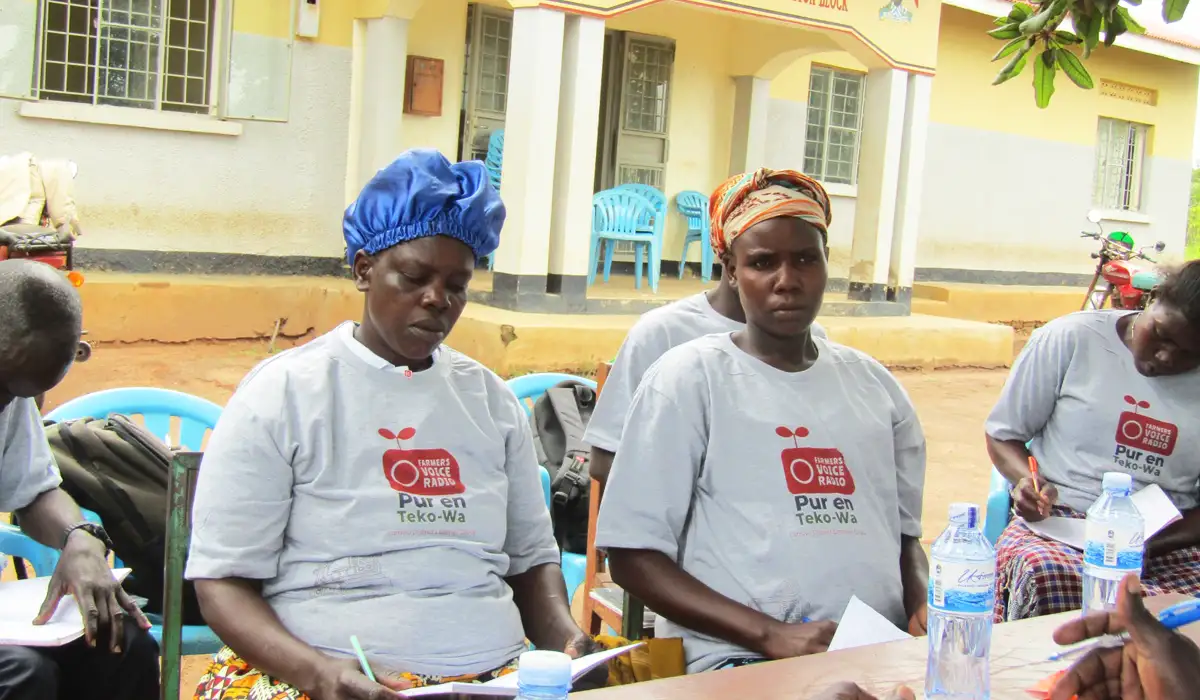
For a long time, Lakisa Oliver’s world was defined by a sewing machine as the main source of revenue. As a tailor in Alenyo North Village, located in Uganda’s Lamwo District, her income was entirely dependent on the next clothing order.
While tailoring provided a modest livelihood, relying on a single, seasonal trade kept true financial security just out of reach. In rural Northern Uganda, where economic vulnerabilities run high, relying on one basket for all your eggs is a risky venture.
Oliver’s trajectory completely shifted when she joined the Pur en Teko-Wa farmer listeners’ group for the Farmers Voice Radio, an initiative by the Environmental Trust of Uganda (ECOTRUST) to enable rural communities to access, share, and apply relevant knowledge in order to improve their livelihoods.
In a remarkable span of just seven months, Oliver transformed herself from a village tailor into a powerhouse of sustainable agribusiness, a champion of value addition, and an influential leader within her community. Her journey stands as a masterclass in how access to information can ignite rapid economic empowerment.
The foundational lesson Oliver gained from the Pur en Teko-Wa radio program was the critical importance of economic diversification.
“When one has multiple sources of income, they get more money and improve their lives significantly,” Oliver explains. “This is why I am investing every amount of money that I get into more agribusinesses to expand my sources of income.”
Driven by this new philosophy, Oliver expanded her economic footprint far beyond her tailoring shop. She dove headfirst into agriculture, cultivating sim sim and sunflowers, while simultaneously launching a poultry farming enterprise. By spreading her economic activities across textiles, crop farming, and livestock, she built a resilient financial safety net that protects her household against market fluctuations and seasonal droughts.
Oliver did not just stop at growing crops; she revolutionised how she sold them. In many rural communities, farmers lose significant profits by selling their raw produce immediately after harvest when market prices are at their lowest.
Through her listeners’ group, Oliver learned the principles of value addition, the process of changing a raw agricultural product into something high-value and consumer-ready.
Instead of selling her raw sim sim seeds, Oliver began processing and packaging them into rich, high-quality sim sim paste. Even in small quantities, these neatly packaged jars are sold at a price of UG 1,000 each, generating higher profit margins compared to wholesale grain.
She applies the same entrepreneurial mindset to her sunflower harvest, processing the seeds to extract pure, organic sunflower oil during the peak seasons.
The increased cash flow from these processed goods is immediately directed into a strategic loop where she saves a portion and reinvests the rest directly back into expanding her production.
Oliver’s success is deeply rooted in her adoption of modern, climate-smart farming techniques. In Northern Uganda, widespread bush burning has traditionally been used to clear fields, a practice that inadvertently destroys vital soil nutrients and organic matter. Through the radio program, Oliver learned the science of proper waste management and land clearing, discovering how to manage agricultural residues to preserve soil moisture and boost crop yields.
Her newfound knowledge also extended to forestry. Oliver has planted over 700 trees covering two acres of her land. This agroforestry initiative serves as a long-term green investment, with the trees earmarked to produce high-value poles and timber that will secure her financial future for years to come.
Crucially, Oliver’s education did not remain trapped on her own plots. She became an active information hub, passing down vital agricultural insights to her family and relatives.
Her husband, who operates a tree nursery business in Lamwo, became one of her most successful students. Oliver influenced him to shift his sourcing strategies toward high-yield, high-quality seedlings, a move that immediately upgraded the health and profitability of his commercial nursery enterprise.
True financial sustainability requires smart saving and market leverage. To secure her earnings, Oliver joined the Pur en Teko-Wa Savings Group, a community financial collective where members contribute money regularly and receive rotating payouts to boost their businesses. It was through this structured saving mechanism that she accumulated the capital needed to purchase day-old chicks, systematically scaling up her poultry farm.
As her yields continue to climb, she plans to team up with the farmers in her group to aggregate their produce and sell it in bulk.
Oliver recognises that while an isolated farmer is often at the mercy of middlemen, a unified group can bypass exploitative supply chains, command higher market prices, and easily attract large-scale buyers.
Lakisa’s seven-month transformation proves that when a woman is armed with the right knowledge and financial tools, she doesn’t just improve her own life; she uplifts her entire family and alters the economic landscape of her community.