
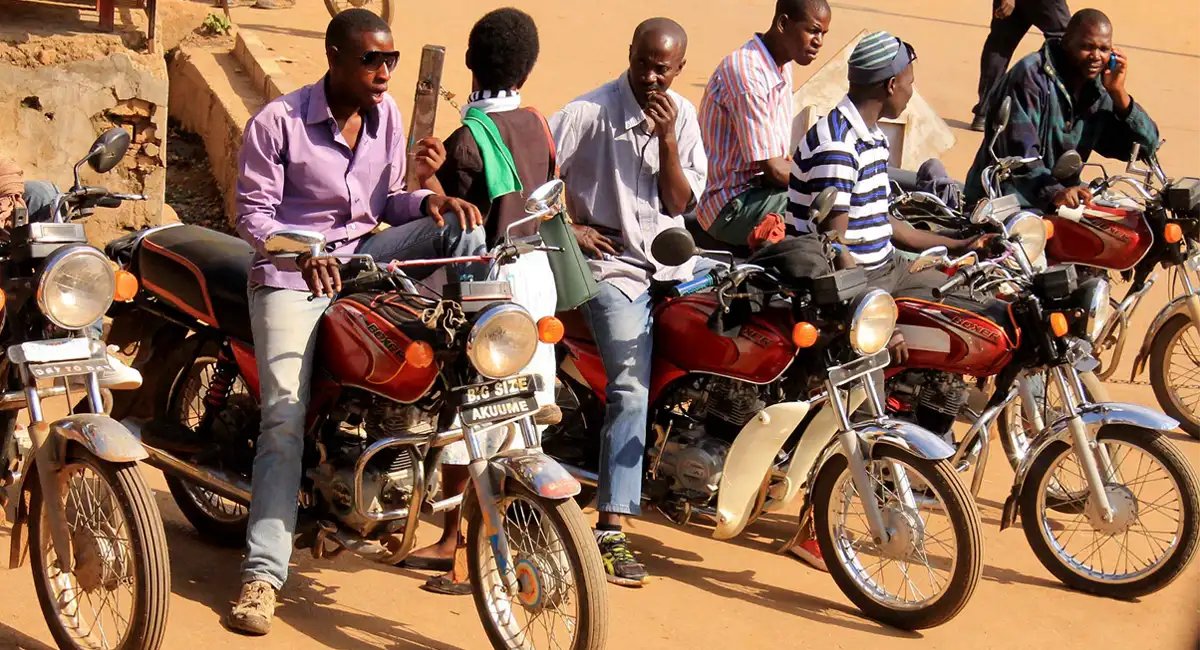
Uganda’s boda boda industry is one of the largest informal employment sectors in the country. It absorbs thousands of job seekers who might otherwise struggle to find work, offering what appears to be a straightforward deal: get a motorcycle, find passengers, earn daily cash.
But for bod boda riders already in the system, that simplicity is deceptive. Easy entry has created a saturated market where survival depends not just on effort but on navigating structural, financial, and social challenges. And now with increasing government intervention, that balancing act is becoming even harder.
#1. KCCA Reforms
In recent years, Kampala Capital City Authority (KCCA) has intensified efforts to reorganise Kampala through decongestion plans, including regulating the boda boda sector. The goal is clear: reduce congestion, improve safety, and restore order in a city heavily affected by traffic and informality.
The reforms include limiting riders to designated stages, capping the number of riders per stage, enforcing strict registration and identification of boda riders, and restricting access to the Kampala central business district (CBD). On paper, the plan is logical. In practice, it creates new barriers.
With only a fraction of current boda riders likely to meet the new requirements, many risk exclusion from high-demand areas in the CBD.
For those already operating on thin margins, being barred from transporting to and within the CBD, a reliable source of well-paying customers, is a major setback.
#2. Stage Politics & Hidden Control System
To an outsider, a boda stage may appear to be nothing more than a waiting point. In reality, a boda stage has its own rules, leadership, and territorial control.
Each stage functions like its jurisdiction. Riders belong to specific stages, and picking passengers from another area is often met with resistance and fines. If you have ever tried to hail a moving Jaj near a stage, you may have witnessed these confrontations firsthand, with fellow riders and authorities of the stage making it as hard as possible for the hailed rider to pick you up.
These unwritten rules determine who gets passengers, when they get them, where riders operate, and how disputes are handled.
KCCA’s attempt to formalise stages also risks reinforcing these territorial systems. By tying riders to fixed locations, it may reduce flexibility and deepen existing power structures rather than eliminate them.
#3. The Hustle for Passengers & Income Pressure
Much like taxis, boda boda riders face a big challenge of finding passengers. These riders endure long waits, and a single customer can spark instant competition. Many also lose money on fuel by cruising on empty bikes, hoping for roadside customers that never come.
For new riders, this environment is even tougher. Without an established presence at a boda stage or repeat customers, securing consistent income becomes a daily hustle, sometimes forcing them to lower fares because, at the end of the day, you need some cash, however little.
#4. Ownership Challenges/Boda Riding Without Owning
One of the most overlooked challenges is that many boda boda riders do not own the motorcycles they use. They rely on hire purchase agreements/boda loans or under a certain mugaga who demands a cut at the end of the day or week.
While this may look like an opportunity for many young people unable to buy a new motorcycle, it means a typical day’s earnings are split before the rider earns anything: the owner’s payment, fuel costs, and the rider’s share for personal use. On days with few customers, little or nothing remains.
And the risks are equally uneven. If a motorcycle is stolen, impounded, or damaged, the rider often carries responsibility for repayments despite not owning it. In effect, many operate under continuous financial pressure with little chance to build long-term stability.
With new regulatory requirements for documentation and formal registration, non-owner riders face an additional barrier; they may not even have the authority or means to comply independently.
#5. Oversupply of Boda Riders & Effects
The large number of boda boda riders, especially in Kampala, has created intense competition, and while the demand remains high, it is not infinite. This saturation has led to a “race to the bottom,” where boda riders compete for the same small pool of passengers; even at half the standard fare, you will still find someone willing to ferry you.
Not only that, but idle time at boda stages has also increased, as roaming riders intercept passengers before they reach designated stages. While KCCA’s attempt to cap numbers may ease this, the transition is likely to face resistance.
#6. Law Enforcement & the Cost of Compliance
In Uganda, any interaction with law enforcement adds another layer of complexity, and for taxi and boda riders, it is even worse. Sudden fines, motorcycle impoundment, and informal payments are typical experiences in a boda business, commonly linked to alleged traffic violations.
In turn, income becomes unstable; you have to look for passengers, but also look out for disruptions that can halt work entirely.
#7. Safety Risks & Long-Term Health Impact on Riders
Boda boda riding remains one of the most physically risky jobs in Uganda. Riders face heavy traffic, frequent accidents, and poor roads where floods and slippery surfaces are common.
The pressure to meet daily loan repayments pushes many boda riders to prioritise speed over safety. Early morning and late-night rides increase risks of theft, assault, including use of hammers (obuyondo) and pavers, and even death. Together, these factors create an environment where danger is a constant reality.
Long-term health is also affected. Continuous exposure to dust, exhaust fumes, and harsh weather leads to breathing issues and eye strain. Long shifts of ten to twelve hours of boda riding on rough roads cause lasting back and joint pain.
This physical strain builds alongside mental fatigue and stress from navigating congested traffic.
Yet despite all these challenges, boda boda riding remains one of the most accessible sectors for many Ugandans.