
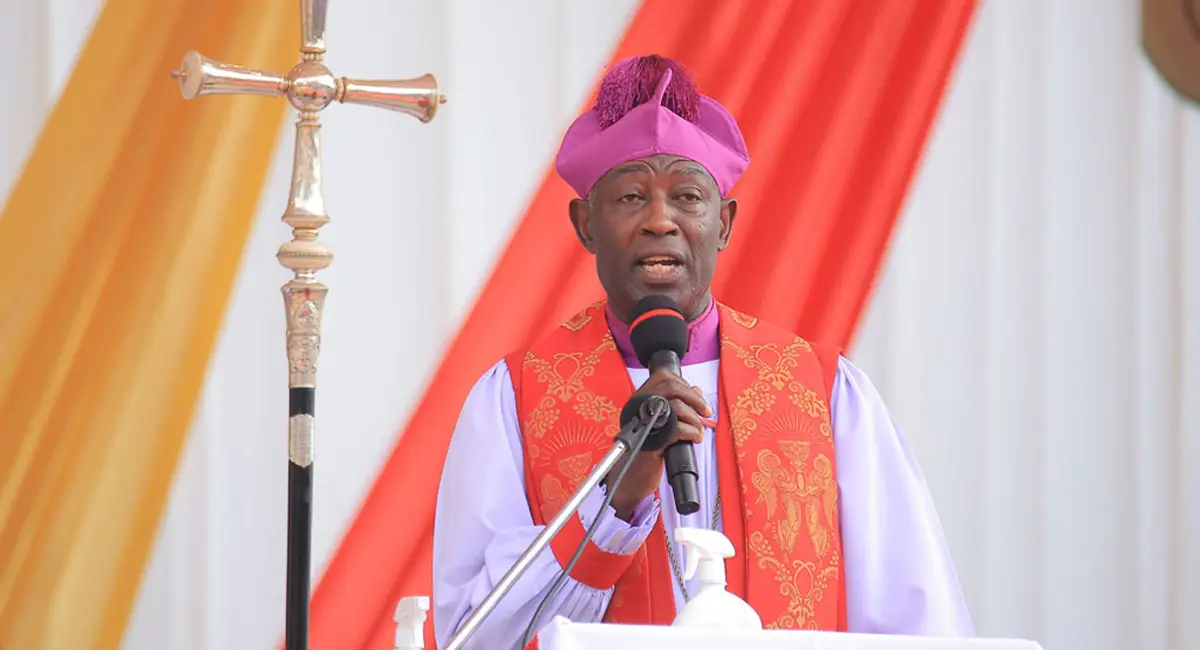
Religious leaders in Uganda are often expected to speak out whenever acts of social or political injustice transpire in the country. For many Ugandans, clerics, not so much as cultural leaders, remain some of the few voices with moral authority capable of challenging those in power. After all, it’s religious leaders who swear these people into power.
Yet many choose silence or cautious language, which in turn flares public frustration. Some Ugandans have openly criticised them by questioning their relevance in moments of national concern.
One of the figures frequently at the centre of such criticism is His Grace Stephen Samuel Kaziimba Mugalu, the ninth Archbishop of the Church of Uganda, who has held the office since August 2019.
On Sunday, 19 April 2026, the archbishop finally broke the silence by publicly addressing the criticism that he and the church had failed to condemn wrongdoing by the Ugandan government.
Speaking during the installation ceremony of Reverend Michael Mukhwana at the newly inaugurated St. John’s Church Archdeaconry Headquarters, Kaziimba Mugalu pushed back against those urging him to speak more aggressively on national issues.
In a sermon that touched on church leadership and public responsibility, one section hit home when he referred to the late Janani Luwum, the second African Archbishop of the Church of Uganda, who was killed in 1977 during the rule of Idi Amin. Kaziimba said:
“The man [Janani Luwum] was killed, so do you think I can make an impact by being killed?… don’t I have a family?”
Kaziimba also emphasised he still has “life to live” and cannot carry every public burden placed upon him. He supported his argument with biblical examples, citing the beheading fate that befell John the Baptist after criticising Herod the Tetrarch, as written in Mark 6:17-29.
Coming days after announcing the death of his father, Mzee Besweri Kaddu, who was laid to rest on Friday, 17 April, the archbishop further stressed that not every message needs to be delivered publicly. On this, he pointed to the biblical case of Nathan the Prophet, who approached King David in 2 Samuel 12 through a parable that led David to reflect on his actions and repent of his wrongdoing involving Bathsheba.
As words from his sermon continue to fuel discussion on social media and beyond, some observers have interpreted Archbishop Kaziimba Mugalu’s remarks as an admission that he fears the consequences of publicly confronting the government. Critics, on the other hand, argue that quiet engagement with the President has produced little visible change and that Uganda’s faith leaders must speak out publicly against injustice in the country.
Despite the criticism, the Most Reverend Kaziimba Mugalu maintains that his role is guided by faith and discernment. His statement, “I choose and follow what God leads me to say,” suggests that his decision on when and how to speak will continue to be shaped by his religious conviction rather than public pressure. What do you think?
WATCH: Archbishop Stephen Kaziimba Mugalu responded to critics urging him to emulate Archbishop Janani Luwum’s bravery in condemning human rights violations, saying he can’t make an impact by getting killed. #NTVNews
📹 @jnalwooga pic.twitter.com/vyJcoQEneI
— NTV UGANDA (@ntvuganda) April 19, 2026