
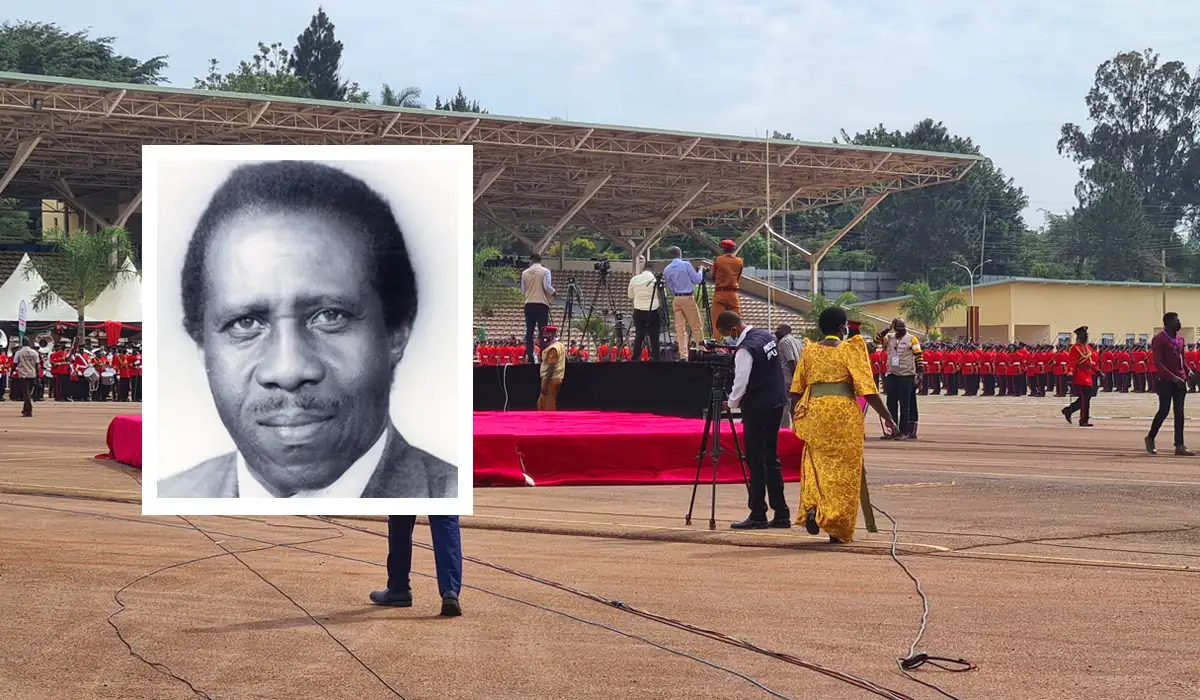
Randomly ask five people in Kampala’s CBD to sing Uganda’s anthem, regarded as one of the shortest anthems in the world, and you’ll be shocked at how most Ugandans can’t sing past the second line in the first stanza of our precious National Anthem, but we’re changing that.
In this article are the lyrics and instrumental of Uganda’s national anthem, titled Oh, Uganda, Land of Beauty. Still, before that, what doesn’t hurt is a little history about this solemn praising anthem that was first performed on 9th October 1962, shortly after hoisting the Uganda flag.
Who Wrote the Uganda National Anthem?
With help from Peter Wingard, a lecturer at Makerere Institute of Teacher Education, Uganda’s national anthem, music and lyrics were composed by George Wilberforce Kakoma. He was born in 1923 at Mengo Hospital to a notable family—his father, Solome Mboolanyi Kakoma, was Gombola chief.
George Kakoma Education and Early Career
Having studied at some of the prestigious schools in East Africa, including King’s College Buddo, where he was a contemporary of Sir Edward Muteesa II, Kakoma graduated from Trinity College of Music and Durham University in London.
Upon returning to Uganda, Kakoma initially struggled to land a job but briefly taught music before joining the Ministry of Education, where he later served as Inspector of Schools in Music. He then became a cultural officer in the Ministry of Culture and Community Development, and it was during this time that he went on to compose the national anthem. Kakoma also organised musical festivals and performed as a soloist with the Kampala Singers.
George Kakoma on the National Symbols Sub-Committee
Following the September 1961 Ugandan Constitutional Conference in London, Benedicto Kiwanuka was appointed Chief Minister before independence on 1 March 1962 to lead the transition to independence. Earlier, in late 1961, Benedicto had introduced a motion to form the National Symbols Committee to create Uganda’s three national symbols: the Coat of Arms, the National flag, and the Anthem.
The committee, chaired by the late Prof. George William Ssenteza Kajjubi, had three subcommittees, each assigned to one symbol. George Kakoma, Prof. Mbabi Katana and John Moon served on the anthem sub-committee.
The subcommittee invited Ugandan composers to submit their entries for a public competition. There was no monetary prize, but recognition on Independence Day was promised.
“The compositions had to be short, original, solemn, praising and looking forward to the future. They had to be harmonised in the usual four parts-soprano, alto, tenor and bass,” Kakoma recalled in a 2003 Interview with New Vision.
George Kakoma Composing the Anthem
Many people submitted entries, but none met the committee’s satisfaction. A late-night announcement on Radio Uganda at 10 p.m. called for more entries, even though the deadline had passed. It was then that George Kakoma and Canon Polycarp Kakooza decided to compose their own pieces. Prof. Senteza Kajubi later recalled in an interview with Daily Monitor how he drove at night to Kakoma’s home in Namirembe and asked him to “forgo his sleep and, since he was a musician, come up with a tune.”
With what he described as a strange melody that wouldn’t leave his mind, Kakoma jotted down the initial notes, without lyrics, in the completely dark room he was occupying. Returning to bed, his mind kept rehearsing what he had committed to paper, and he continued adding details and refining the tune until daybreak.
That morning, he recalled: “I sat down and looked through what I had ciphered during the night hours. I worked on those ideas till midday.”
The following day, he travelled to Kampala to meet Kajubi, who advised him to train a student choir from Gayaza High School and Buddo to perform the piece, then record it on a magnetic tape. After consulting with Peter Wingard, the two agreed on the arrangement, and Kakoma trained the choir himself. When all was ready, “I rushed to the Chairman and handed him the required recording.”
“Kakooza’s tune was good but long. Kakoma’s had one advantage: it was short and easy to learn,” Prof. Kajubi later explained, who submitted both tunes to the cabinet.
Adoption of Oh, Uganda, Land of Beauty
In July 1962, Kakoma’s Oh, Uganda, Land of Beauty composition of music and lyrics was officially adopted, declaring him the winner over other composers.
“I was sceptical and couldn’t believe my ears … until my friends rang me and some came to congratulate me,” Kakoma told New Vision.
This version of the Uganda National Anthem had its first public performance at the Independence ceremony on October 9, 1962. It was played instrumentally by the Police Band, led by music director Mr John Moon, and sung by a choir from Makerere College School conducted by 14-year-old Catherine Mwandha. The new anthem officially replaced God Save the Queen after the lowering of the Union Jack.
Months before independence, in April 1962, the newly elected cabinet, following the Democratic Party’s loss to the Uganda People’s Congress and Kabaka Yekka alliance, finalised the national symbols. Only the flag underwent modification to its current form.
As a token of appreciation, Prime Minister Milton Obote’s government awarded George Kakoma UGX 2,000 for his composition, a sum that would later become part of the long-running copyright dispute.
Lyric Change: Including God in the Anthem
In December 1962, two months after Independence, the Government of Uganda agreed to change the first line of the national anthem, revising it from “Oh Uganda, may thy people uphold thee” to the current “Oh Uganda, may God uphold thee.” This modification was made in response to a 21 August 1962 letter of protest—days before Independence—from the bishop, later the first black Archbishop of the Church of Uganda in 1966, Erica Sabiti, who wrote, “I feel that Uganda is a religious country and it is a pity that the word God is not named in her anthem.” Sources indicate there was an inaugural broadcast of the anthem on 9 August 1962 on Radio Uganda.
Uganda National Anthem Instrument and Lyrics
II
Oh, Uganda! May God uphold thee,
We lay our future in thy hand;
United, free for liberty
together we’ll always stand.
II
Oh, Uganda! The land of freedom,
Our love and labour we give;
And with neighbours all at our country’s call
In peace and friendship we’ll live.
III
Oh, Uganda! The land that feeds us,
By sun and fertile soil grown;
For our own dear land, we shall always stand,
The Pearl of Africa’s Crown.
George Kakoma Exile Under Idi Amin
In January 1975, following political turmoil under Idi Amin’s regime, Kakoma and his family went into self-imposed exile in Kenya, where he taught music at Kenyatta University until 1986, when the NRA captured Kampala. The instability had also prevented him from pursuing claims for fair compensation for his work.
Legal Battle Begins
In 2008, Kakoma sued the government for over 40 years of royalties, claiming he owned the copyright since he composed the anthem before the government’s competition, while the government argued it was a commissioned work and therefore theirs.
High Court Ruling and UGX 50 Million Award
In 2010, High Court Judge Yorokamu Bamwine ruled that the copyright was dual: Kakoma held a legal interest, while the government held an equitable one due to later amendments to the composition. The court awarded Kakoma UGX 50 million, after he had rejected an out-of-court government offer of UGX 150 million, insisting on £1.5 million, prompting both him and the government to appeal the ruling.
On Easter Sunday morning, 8 April 2012, Prof. George Wilberforce Kakoma died at the age of 89, without receiving the compensation he sought, a legal battle that his widow, Mary Teresa Kakoma, continued as administrator of his estate.
Court of Appeal Verdict: Anthem in Public Domain
Following the appeal case filed by Kakoma before his death, the Court of Appeal finally delivered its judgment on 15 July 2019. The panel, consisting of Justices Elizabeth Musoke, Fredrick Egonda-Ntende, and Hellen Obura, overturned the High Court’s 2010 ruling. The court ruled that under the Copyright and Neighbouring Rights Act of 2006, the copyright of the national anthem belonged to the government, which had initiated, managed, and made amendments to Kakoma’s original composition. Consequently, the UGX 50 million award was cancelled, with the court stating it had “no legal basis,” and noting that the token payment of UGX 2,000 Kakoma received in 1962 constituted sufficient compensation for his work.
The ruling ended the family’s fight for compensation, effectively placing the Uganda national anthem in the public domain for free use by the state. Just over a month later, on 27 August 2019, Mary Teresa Kakoma passed away.
If you like this kind of content, tap the icon on your left screen to join our WhatsApp Channel.