
As the project nears its end, the two-year Investing in Forests and Protected Areas for Climate-Smart Development (IFPA-CD) MAS Project is concluding its operations under the Government of Uganda’s Ministry of Water and Environment. Funded by the World Bank, this initiative focuses on implementing intensive, mixed-use agroforestry systems on household plots.
By integrating trees, crops, and livestock into local farming setups, the project aims to counter environmental degradation, boost land productivity, and improve food security and livelihoods across nineteen refugee-hosting districts in Northern and Western Uganda.
The massive project relied on a strong network of partners for its field execution. Catholic Relief Services (CRS) served as the primary consultant for the ministry, partnering with NIRAS International Consulting Uganda and the Environmental Conservation Trust of Uganda (ECOTRUST). As a sub-consultant, ECOTRUST took the lead on managing community implementation within five specific refugee settlement districts: Kamwenge, Lamwo, Kagadi, Kakumiro, and Kitagwenda.
Through inclusive community mobilisation, the IFPA-CD MAS Project set ambitious targets to reach 87,782 households and restore 17,550 hectares of degraded land. As the two-year intervention wrapped up, its real-world impact was celebrated locally. In Kagadi District, the project recognised and rewarded more than 20 outstanding model farmers across four sub-counties, honouring their exceptional commitment to tree planting and sustainable farming practices that will safeguard the region’s climate future.
Through the project, each farmer received over 5,000 tree seedlings of different species, which they planted and nurtured on their farms, demonstrating strong environmental stewardship. The project focused on planting indigenous tree seedlings such as Albizia, Prunus africana, Grevillea, Terminalia, Maesopsis, and Mahogany.
“These particular seedlings were supplied to the farmers because they align with agroforestry practices and have a higher survival rate in the region based on our review process. The species were also selected and distributed according to individual farmer choices,” said Christopher Byamukama, the project officer for the IFPA-CD MAS Project in Kagadi District.
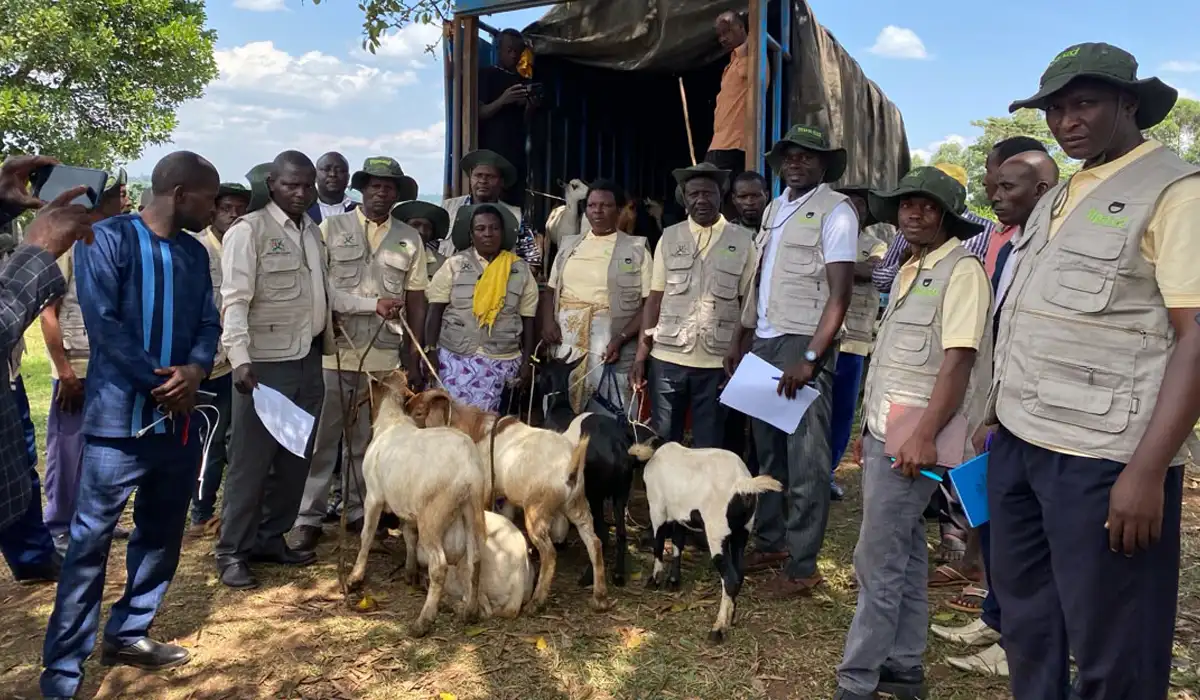
In recognition of their efforts, recently, each of the model farmers was awarded two goats to strengthen household incomes and improve livelihoods at the Kagadi District headquarters where the handover was carried out.
The distribution marked an important close-out activity of the IFPA-CD MAS Project in Kagadi District, which has been among the best-performing districts under the World Bank-funded initiative.
Kagadi District LCV Chairperson Tumusiime Elly commended the farmers for their dedication, noting that their efforts have made them role models within their communities.
“The agroforestry initiative will improve soil fertility, restore rainfall patterns, and support sustainable livelihoods, while the distribution of goats is expected to boost household incomes through breeding and livestock production. I encourage farmers to view these animals as capital for the future, rather than a quick fix for immediate challenges,” Tumusiime said.
Across all implementation areas, the project aimed to promote agroforestry adoption among 87,782 households. In total, 25,314 farmers were reached against a target of 25,807, demonstrating strong performance across districts. Kagadi District emerged as the top performer, reaching its target of 7,180 households.
This reflects strong community participation and commitment to integrating trees into farming systems to improve soil fertility, food security, improve livelihoods, and promote climate resilience.
Under the land restoration component, the project aimed to restore degraded landscapes and strengthen ecosystem services. Kagadi District once again exceeded expectations, meeting and surpassing its target by planting trees across 1,420 hectares of land.
These efforts have contributed to improved watershed protection, increased tree cover, and enhanced environmental sustainability.
Community engagement was strengthened through the Farmers’ Voice Radio approach, which uses radio as an innovative way of providing vital information to farmers while promoting two-way dialogue between farmers and experts. The approach was implemented through Kibale Kagadi Community Radio, often known as KKCR 91.7 FM, enabling farmers to interact with experts on radio, share challenges, and receive agricultural information and practical guidance in local languages.
Tom Kizza, a model farmer from Isunga sub-county, shared his experience: “Before the project came, I had a coffee garden but lacked knowledge about the importance of shade trees. Through the project’s training, I learned how integrating trees into my farm could improve coffee production and protect the environment. Through the project, I received over 700 tree seedlings, including mahogany, grevillea, coffee, and cocoa, and I am proud that all of them are growing well. I have also gained a lot of knowledge from the Farmers’ Voice radio program, and I am confident that I will take proper care of these animals to boost my returns even more.”
Abigaba Patrick, the District Forest Officer and focal person for the project in Kagadi District, also appreciated the initiative, noting that the project’s training and the distribution of tree seedlings and goats will help communities improve their incomes while protecting forests.
“In Kagadi District, over 60% of the forest reserves have been degraded. Working through this project is enabling the district to restore these degraded areas while improving the livelihoods of rural farmers by providing alternative sources of income. As a district, we have also noticed a growing understanding among community members regarding the importance of nature protection,” he said.