
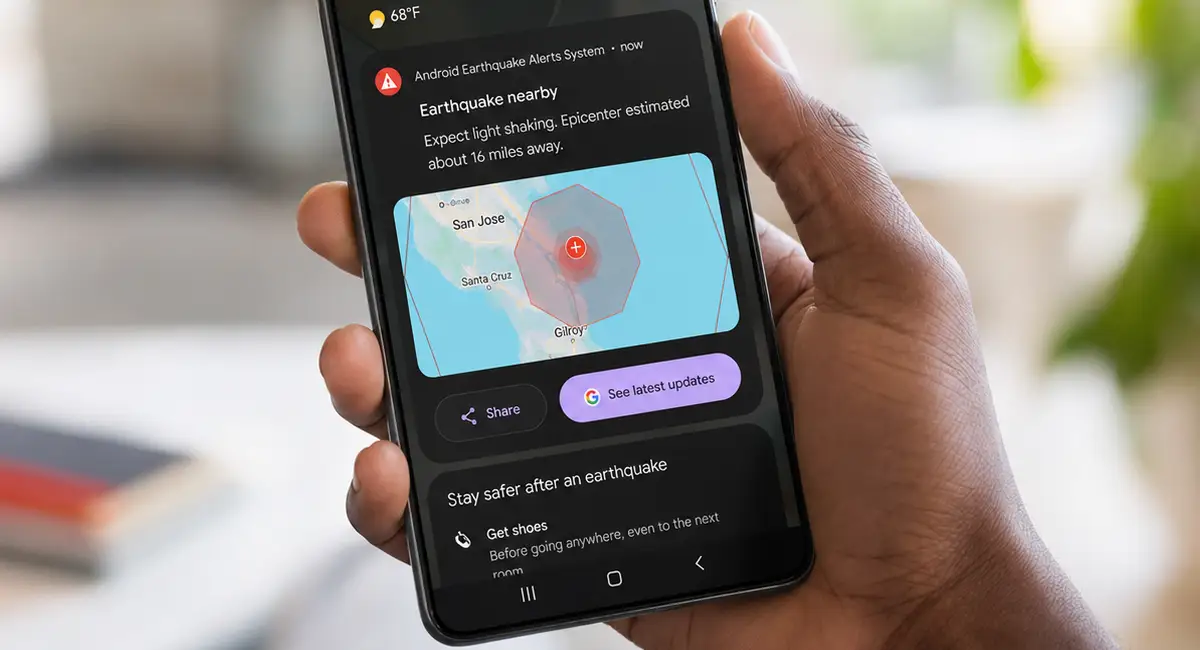
When an earthquake hit central Uganda on 31 March 2026, many Android phone users in the affected areas received a notification. For some, it lit up their phones before the shaking, and for others, a few seconds later.
Those who saw the alert before impact, the idea that a smartphone could predict a natural disaster raised an immediate question.
The alert comes from the Android Earthquake Alerts System, developed and globally launched by Google in April 2020. It doesn’t actually predict earthquakes; instead, the Android Earthquake Alerts System detects an earthquake at its epicentre right as it begins and warns people farther away before the shaking reaches them.
The system reacts in real time, using data signals that travel faster than earthquake waves.
How Does the Android Earthquake Alerts System Work?
Every Android phone has a small sensor called an accelerometer. It detects movement and orientation, for instance, when you hold your phone sideways, the accelerometer rotates the screen for you.
Every time a phone detects a strong and unusual vibration, it sends a signal to Google’s servers. On its own, that signal does not mean much; it could be a dropped phone, a rough road, or someone running with the device.
But when hundreds or thousands of phones in the same area report similar shaking at the same time, the system begins to recognise a pattern that suggests something larger is happening underground.
Google systems then combine all incoming signals and check them for consistency in both location and timing. In seconds, it can estimate the likely epicentre and the earthquake’s magnitude.
Once the earthquake (seismic activity) is confirmed, alerts are sent almost instantly to Android phones in potentially affected areas. While earthquakes travel fast, reaching up to 8 Km/s, they are no match for data, which travels at the speed of light. By outrunning the physical shaking, the Android Earthquake Alerts System delivers life-saving warnings in mere milliseconds.
Though incredibly fast, the system cannot safeguard people at the epicentre; they feel the impact before an alert is processed. However, those a few kilometres away benefit from internet speeds that beat the earthquake, giving them a few seconds to take cover. In the most recent earthquakes that hit Venezuela on Wednesday, 24 June 2026, Google Earthquake Alerts reportedly warned about 11.4M phone users before impact, allowing some up to 2 minutes to act.
Useful tool! You might be wondering how to turn on Google’s Android Earthquake Alerts. You don’t; it’s already enabled by default on Android devices, but it requires location and an active internet connection (Mobile data or Wi-Fi) to send and receive alerts.
And finally, the big question: Is Google tracking every single movement your phone makes? Yes. Google constantly monitors Android accelerometers. While they state this data is anonymised, Android phones continuously transmit it to their servers, where it is aggregated to detect seismic activity.
This global data collection is also why iPhones don’t have built-in earthquake detection; Apple relies on government-run seismic systems to send alerts.